How can a child remember all the spellings of one vowel sound?
By Dr. V.S. Gayathri ·
writing dyslexia
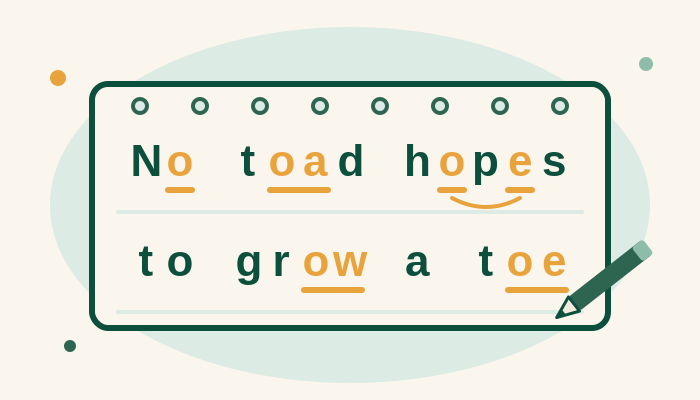
The key-sentence tool is one short sentence, learned by heart, that holds the main spellings of a single vowel sound, one spelling to a word. The child writes it from memory, underlines the letters that make the sound, and later uses it to decide which spelling a word needs. I teach it once a child reaches the long vowels.
What is a key sentence?
A key sentence gives a child one sentence for one vowel sound, and each main word in the sentence spells that sound a different way.
Here is a key sentence written for this post, so you can see how one works. The sound is long o, the vowel sound in “go”.
No toad hopes to grow a toe.
Five words carry the sound, and each spells it differently: o in “no”, oa in “toad”, o with a silent e in “hopes”, ow in “grow” and oe in “toe”. The o in “to” is left alone, because it makes a different sound.
My students have a key sentence for long a, long e, long i and long o, and one for the “er” sound in “fern”, “bird” and “turn”.
English needs a tool like the key sentence because it has far more spellings than sounds. Louisa Moats, writing in the Winter 2005-06 issue of American Educator, counts about 40 speech sounds and more than 250 ways to spell them.
Why does a sentence hold better than a list of spellings?
A sentence holds better than a list of spellings, in my experience, because five loose letter patterns are hard to keep and one sentence is easy. That is how I explain it to children: for /m/ you almost always write m, for /k/ you have a few choices, and for long a, the way I teach it, you have five. I have seen a child who could not name a spelling find it by saying the sentence.
The International Dyslexia Association’s fact sheet on spelling says that a general kind of visual memory plays a relatively minor role in learning to spell, and that writing a word many times until it sticks is useful only after a child understands why the word is spelled the way it is. I take that further in spelling is not a matter of memorization. Each spelling in a key sentence is taught and practised in words, and the sentence is where the spellings are stored together.
I know of no study that tests key sentences by themselves. The tool is built from two habits I rely on. One is teaching the spellings of one sound as a group: Moats writes that people who do not absorb spellings from reading mainly need to practise recognising and writing groups of words that share a pattern. The other is asking a child to recall from memory.
How is a key sentence taught and practised in a session?
A key sentence is taught when a child reaches a sound with several spellings. We collect the spellings the child already knows for that sound, I give the sentence, and it goes at the top of a notebook page with a column under it for each spelling. Words are sorted into the columns, and a story gives the child the same spellings to find in print.
After that, the key sentence comes back for a few minutes near the start of a session, in the opening review I describe in what happens in online dyslexia intervention.
- The child writes or types the sentence from memory, with no copy in view.
- The child underlines only the letters that make the sound, never the whole word. In “grow” that is ow, the same two letters the child will need for “snow” and “window”. In “hopes” the o and the e are underlined and the p is left out. In a word like “night”, three letters, igh, are underlined together because together they make one sound.
- I ask why those letters are underlined, and the child tells me that those letters make the sound.
- The child reads back what is on the page, word for word, and corrects it.
When a sentence has slipped, I take it off the screen, the child says it from memory, and I ask for it again at the start of the next class. When a child cannot recall a key sentence at all, I give a hint or say where it sits in the notebook. I do not dictate it.
Asking for a key sentence cold, after a gap, is deliberate. What a child can and cannot recall after a few days shows me what has been kept, and recalling also strengthens memory. In a 2006 study in Psychological Science, Henry Roediger and Jeffrey Karpicke found that students who were tested on a passage remembered more of it a week later than students who reread it. That study used prose passages, not children learning spellings, so I take it as support for the habit of recalling and no more.
How does a child use a key sentence to choose a spelling?
A child uses a key sentence as a lookup, and that matters more than being able to recite it. The sentence answers the first question a speller has: what are my choices for this sound?
The second question is which choice fits this place in the word, and English often settles that by position. Louisa Moats names it as a principle of English spelling: the spelling of a given sound can vary according to its position within a word. For long o, I teach that oa usually comes in the middle of a word and ow at the end. The position rule is taught beside the key sentence, and the sentence brings the rule back: “toad” has its oa in the middle, and “grow” has its ow at the end.
A student asked which spelling fits long o at the end of a word guessed first. The key sentence was still on the screen, so I pointed to it. The student looked, and gave me the rule back: ow at the end, oa in the middle.
One sound can have five spellings. A child does not have to carry five loose facts. One sentence carries them.
The key sentence also helps when a child cannot think of a word. Another student, asked for a word in which y says long i, kept offering words spelled with the letter i. I asked what we do when we do not know. The answer was to say the sentence, and the word was in it.
What goes wrong with key sentences?
Two things go wrong with key sentences in my sessions.
The sentence drifts. A child swaps in a word that still makes sense, and the new word spells the sound another way or does not carry it at all. If “hopes” turned into “wants” in “No toad hopes to grow a toe”, the silent e spelling would be lost and nobody would notice. I check the sentence word for word, every time.
The sentence becomes a recital. A child can say a key sentence perfectly and still not use it when writing. When a spelling slips, I usually point to the sentence before I give the answer.
Can a parent use a key sentence at home?
A parent can use a key sentence at home. Keep it small. If your child is learning key sentences in class, ask for one from memory every few days and let your child check it against the notebook. When a vowel spelling is stuck during homework, say “check your key sentence” and nothing more. One mother does this during our sessions, as I describe in parent in the room.
A key sentence has limits. It gives the choices for a sound, but it cannot tell a child whether the word is “road” or “rode”. Irregular words such as “said” and “people” are outside it. A child who is still unsure of short vowels and single consonants does not need a key sentence yet, and an older child starts with those sounds too, as I explain in why an older child starts at vowel sounds again. A key sentence stores what has been taught. The teaching still has to happen.
Frequently asked questions
How long does it take a child to learn a key sentence?
Saying a key sentence takes practice, and it slips after a break, which is why I ask for it cold. In my sessions the first long vowel pattern, with its sentence, sorting table and position rules, takes weeks, and later vowels go faster because the routine is familiar. It varies from child to child, and I describe that stage in what progress looks like before reading becomes fluent.
Does a key sentence replace the school spelling list?
No. A school spelling list is a set of words, and a key sentence is a set of spellings for one sound, so they do different jobs. What a key sentence adds is a way to work out a word that was never on a list. The International Dyslexia Association makes the wider point that students should learn to spell words for writing and not just for spelling tests.
How do we start?
Families without a detailed diagnostic report begin with the Reading & Spelling Snapshot at Flourishing Kids, an informal reading and spelling assessment held online, one to one, in about 60 minutes with your child. You receive a written report, and we go through it in a follow-up discussion of about 60 minutes on a separate day. Assessment fee: USD 150. Class plans and fees are personalised and discussed at that follow-up.
Dr. V.S. Gayathri is a Dyslexia Therapist, an Orton-Gillingham trained literacy specialist, and the founder of Flourishing Kids. She has delivered over 4,000 hours of one-to-one reading and spelling intervention, helping children across multiple countries build stronger literacy skills. If your child learns spellings for the test and has lost them a week later, get in touch for a free 15-minute conversation.