Spelling is not a matter of memorization
By Dr. V.S. Gayathri ·
writing learning
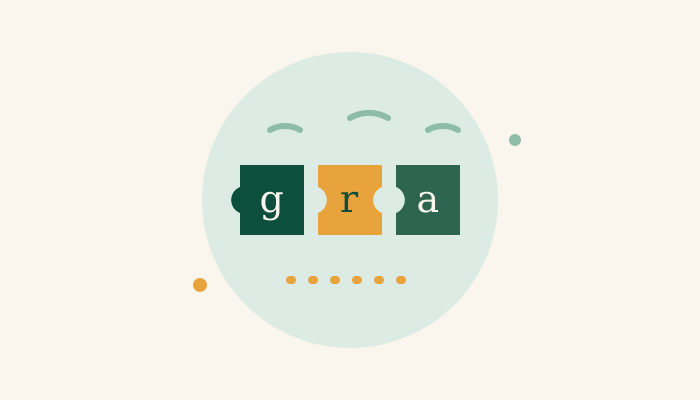
Spelling is not learned by memorising letter strings; rote visual memory holds only two or three letters of a word. Spelling is learned through the sounds of language, letter patterns and word origins, and nearly half of English words are fully predictable from teachable sound-letter correspondences, with another third off by just one sound. Teach the system, and the spellings follow.
“Spelling is the foundation of reading and the greatest ornament of writing,” wrote Noah Webster in 1773. Spelling is critical for literacy: to put a thought into writing, the letters must be right, because one letter here or there changes everything. As children learn to spell, their knowledge of words deepens and reading itself becomes easier.
Yet in the elementary grades, spelling is usually taught as an isolated, visual task: flashcards, or writing each word five to ten times. The research does not support it. Studies find rote visual memory for letter strings limited to two or three letters, and the errors children make show something other than visual memory at work. What does produce results is instruction based on the sounds of language, because learning to spell and learning to read rely on the same underlying knowledge: the relationships between letters and sounds. That is also why spelling and reading comprehension correlate so strongly; the more thoroughly a student knows a word, the more likely they are to recognise it, spell it, define it, and use it well.
How should spelling be taught?
English spellings are governed by letter positions within words, meaningful word parts, and the history of English. So learning about words and the language is what improves spelling. The numbers are encouraging: research indicates nearly 50 percent of English words are predictable from teachable sound-letter correspondences, and another 34 percent are predictable except for a single sound. The system, taught in the right order, carries the child:
- Kindergarten: activities that heighten awareness of the sounds of language and build letter-name and letter-sound knowledge. By year’s end, a child should quickly name letters on a chart and give the sounds of single-sound letters (b, d, f), with plenty of chances to write and connect speech to print.
- Grade 1: Anglo-Saxon words with regular correspondences: one-syllable words with short vowels and the common consonants. Two workhorse patterns arrive here: the final e that marks a long vowel (name, five, rope, cube), and the “floss rule” (after a short vowel, final /f/, /l/ and /s/ double: stiff, well, grass).
- Grade 2: more complex Anglo-Saxon patterns and the common endings, -ing and -ed.
- Grade 4: Latin prefixes, suffixes and roots: vis (television), audi (auditorium), duc (conductor), port (transportation), spect (spectacular).
- Grades 5 to 7: Greek combining forms: photo, phono, logy, philo, tele, thermo.
A child asked to memorise “spectacular” gets eleven letters. A child taught spect gets fifty words.
What do good spelling programmes look like?
Language-based programmes, focused on sound-letter correspondences, beat visual-memorisation approaches in the research, and they supply the grade-by-grade sequencing that makes the system stick. Two well-regarded examples: Primary Spelling by Pattern (Ellen Javernick and researcher Louisa Moats) for grades 1 to 3 or older strugglers, and Spellography (Louisa Moats and Bruce Rosow) for grades 4 and 5 or middle-graders needing more structured language work.
A two-tier early-intervention model from the research is worth knowing: first teach the alphabetic principle and sound-spelling connections with real practice, spelling words singly and in composed text; then monitor children the following year and keep tutoring whoever needs it. Spelling disability is largely preventable when the teaching starts from sound.
Can’t spell checkers handle it?
No. Spell checkers help people who already spell reasonably well; they cannot compensate for poor spelling. They fail on homophones (here versus hear), catch only 30 to 80 percent of misspellings overall, and in one study identified the intended word from the misspellings of students with learning disabilities just 53 percent of the time. The tool needs a speller to operate it.
Visual memory does play a role, but it works through understanding: memory for spelling patterns is built on speech sounds, sound-letter correspondences, word origins and meaningful word parts. As the experts put it, spelling is a psychological, linguistic and conceptual process involving the alphabet, syllables, meaning and word history. The main mechanism is not a photographic memory; it is insight into why words are spelled the way they are. For children with dyslexia, for whom spelling is often the hardest front of all, that insight is the only route that works, which is why structured literacy teaches spelling exactly this way.
Dr. V.S. Gayathri is a Dyslexia Therapist, an Orton-Gillingham trained literacy specialist, and the founder of Flourishing Kids. She has delivered over 4,000 hours of one-to-one reading and spelling intervention, helping children across multiple countries build stronger literacy skills. If spellings refuse to stick for your child, get in touch for a free 15-minute conversation.