All about dyslexia: a parent's complete introduction
By Dr. V.S. Gayathri ·
dyslexia
Dyslexia is a Specific Learning Disorder with impairment in reading: a neurological, brain-based difference that makes reading, writing and spelling hard, with no relation to intelligence. India’s Department of Biotechnology estimates around 10 percent of children here have it, roughly 35 million. It is not a disease, and with early, structured intervention, children with dyslexia learn to read well.
Most of India met dyslexia through the film Taare Zameen Par, yet many people still misread it: some treat it as an incurable illness, others dismiss it as laziness or bad parenting. Neither is true. Dyslexia is a difference in how the brain processes written language, not a disease, not a choice, and not a “learning style”. Let us take a proper look.
What is dyslexia?
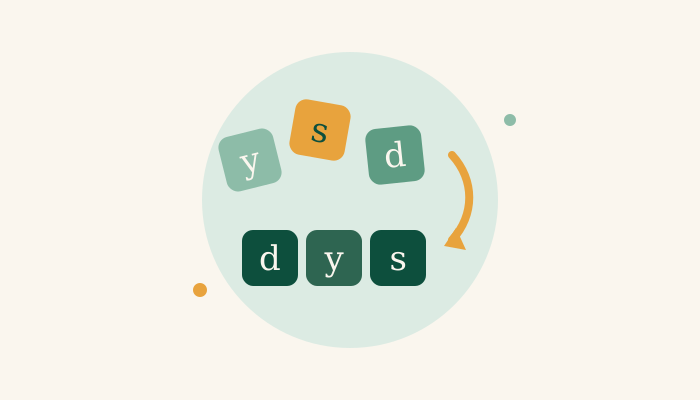
The word comes from dys, meaning difficulty, and lexis, meaning words. Dyslexia is a neurological condition affecting a person’s ability to read, write and spell: a child with dyslexia finds it hard to read words and understand language in print. That does not make the child “disabled” or “abnormal”. Intelligence is unaffected; many of these children are strikingly creative, and their thinking strengths often shine exactly where print is not involved. (The full set of misconceptions deserves its own reading: top ten myths about dyslexia.)
Between 5 and 10 percent of the world’s population is estimated to have dyslexia; some Indian studies put the local figure as high as 17 percent. With India’s huge young population, parents, teachers and students all need to understand the real problem, because the gap closes fastest with early and better intervention.
What are the symptoms of dyslexia?
Visible signs include speech difficulties, limited vocabulary, and trouble decoding symbols and sounds. The pattern varies from child to child, so avoid comparing children or drawing conclusions from someone else’s case. Classic tells: mixing up letters in reading and writing (b for d), and calculation errors from not seeing numbers in sequence.
Bishop and Snowling’s research identifies the most common characteristics: memory difficulties, organisational difficulties, and difficulties with writing, reading and time management.
A few numbers worth knowing. A child has roughly a 50 percent chance of dyslexia if one parent has it, and higher still if both do (the hereditary picture is worth understanding). Severity ranges from mild to severe. Around 40 percent of people with dyslexia also have ADHD. And people with dyslexia spend about five times more energy on the same mental tasks, which is why these children come home from school exhausted.
Where does dyslexia show up?
Reading
Reading is measured by word reading accuracy and fluency, and both run lower in dyslexia. Words are built from individual sounds that these children cannot always decode, which is why rhyming is hard, and why comprehension, the whole point of reading, suffers downstream. Specialised, structured reading techniques exist precisely for this; the Orton-Gillingham approach is the best known.
Spelling
Spelling difficulty drags reading down further, and for some people with dyslexia, learning to spell is even harder than learning to read. Typical patterns: confusing letters with similar sounds, trouble with vowels, mixed letter order (felt for left), and misspelling common sight words even after heavy practice.
Writing
Expressing thoughts in writing is the third front, driven by the same phonological deficit: poor spelling, poor legibility, thin vocabulary, underdeveloped ideas, and weak organisation and structure on the page.
A dyslexic child works five times harder to read half as much. What looks like laziness is usually exhaustion.
What should parents and teachers do?
Remember that dyslexia is not a disease; it is a brain-based difference, and the brain rewires with the right teaching. Early identification and intervention decide how the story goes, so knowing the early indicators matters more than any label. And instead of singling dyslexic children out, include them; their daily courage deserves it.
Dyslexia does not cap anyone’s height. The inspiring examples are everywhere: Tom Cruise, Abhishek Bachchan, Walt Disney, Steven Spielberg, Muhammad Ali, all of whom refused to let the condition define their limits. A child with dyslexia, and their parents, should know one thing above all: you are not alone.
Frequently asked questions
Is dyslexia curable?
There is no cure because there is no disease. There is highly effective teaching: structured, explicit, multisensory literacy instruction reliably teaches children with dyslexia to read. The earlier it starts, the smaller the gap ever gets.
How is dyslexia diagnosed in India?
A formal SpLD assessment by a qualified psychologist or a certified dyslexia specialist, usually possible from around age eight. But screening and structured support can and should start much earlier, from the first persistent signs.
Dr. V.S. Gayathri is a Dyslexia Therapist, an Orton-Gillingham trained literacy specialist, and the founder of Flourishing Kids. She has delivered over 4,000 hours of one-to-one reading and spelling intervention, helping children across multiple countries build stronger literacy skills. If you suspect dyslexia in your child, get in touch for a free 15-minute conversation.