What happens to our brain when we start learning?
By Dr. V.S. Gayathri ·
learning
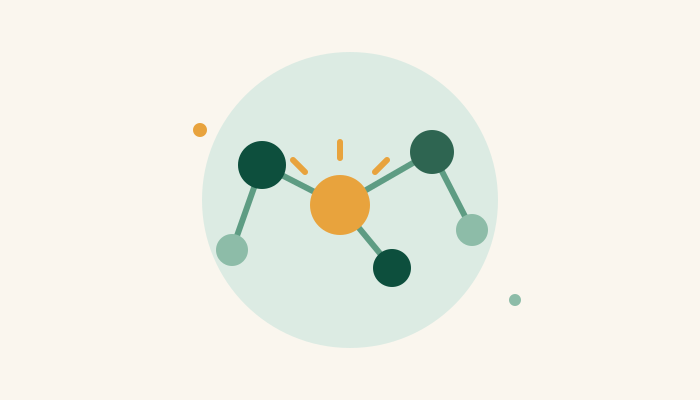
When we start learning, neurons in the brain form new connections at their meeting points, the synapses, and repetition strengthens those connections until recall becomes instant. Learning physically changes the brain’s structure, including the insulating myelin that tunes how fast signals travel. This keeps happening across the whole of life.
Learning is lifelong, and the brain is built for it. Alongside its biological housekeeping, the brain’s purpose is to learn and to act on what it has learned, and it does this naturally all day, every day. Activities the brain repeats become easier to complete, and what we learn and do literally changes the brain’s structure. Research shows the human brain keeps changing throughout life: forming connections with new cells, while other cells fall silent.
One reassuring number: the brain’s information storage capacity is estimated at around a quadrillion bytes, a 1 followed by 15 zeroes. Storage is never the problem. The flow of information in and out of memory is where the difficulties arise, which is exactly where teaching quality matters.
How does the brain learn?
The brain’s building blocks are neurons, about 86 billion of them in each of us.
- Learning happens at the synapses, the connecting points between neurons. On their own, synapses store only the most elementary reflexes.
- Real learning and memory couple information across many brain regions. That coupling alters the physical structure of myelin, the insulation around the wiring that connects neurons.
- Myelin adjusts the transmission speed through neural networks, which is a key part of how practice turns effortful skills into fast, automatic ones.
The practical consequence for every student: spread learning across many days, repeating the task. Repetition lets neurons strengthen steadily; new information gets associated with the task; active memory neurons form new connections and reinforce old ones. With time, comprehension reaches the level where you just get it, instantly. This is precisely why repeated reading works, and why cramming does not.
”Learn it, link it”
When students actively focus on learning, the connecting begins: in class listening to a lecture, at home reading, or wrestling with a problem. The more often they do it, the more connections form; as learning continues, neurons keep linking and strengthening. Teachers call the process learn it, link it.
There is a hopeful message inside this for every struggling learner: the brain that finds reading hard today is not fixed. It is rewireable, and with the right structured input it rewires; that neuroplasticity is the entire scientific basis of dyslexia intervention. Difficulties like a smaller working memory are real, but so is the brain’s capacity to build routes around them.
Every practice session is construction work. The child cannot see the wiring being laid, and neither can you, until one day the word reads itself.
What happens when you stop learning new things?
A British research study connected long-term boredom with health itself: people who reported being bored over a long period had heart disease rates more than twice as high as those who did not. Without new experiences and learning, the brain slows and grows less responsive.
The takeaway holds at every age: keep learning, at your own pace, from time to time. For children the stakes are development; for adults, maintenance. Either way, the brain rewards use.
Frequently asked questions
How many repetitions does it take to learn something?
There is no fixed number; it depends on the complexity of the skill and the quality of practice. The reliable rule is distribution: five short sessions across a week build far stronger connections than one long session, because myelin and synapses strengthen between sessions, not just during them.
Does this apply to children with learning difficulties?
Especially to them. Their brains form the same connections; some pathways simply need more repetitions and more explicit teaching to build. That is not a flaw in the child; it is a specification for the teaching.
Dr. V.S. Gayathri is a Dyslexia Therapist, an Orton-Gillingham trained literacy specialist, and the founder of Flourishing Kids. She has delivered over 4,000 hours of one-to-one reading and spelling intervention, helping children across multiple countries build stronger literacy skills. built on exactly this science. To talk about what your child’s brain needs to link the learning, get in touch for a free 15-minute conversation.