b and d confusion in kids: why it happens and how to fix it
By Dr. V.S. Gayathri ·
reading learning
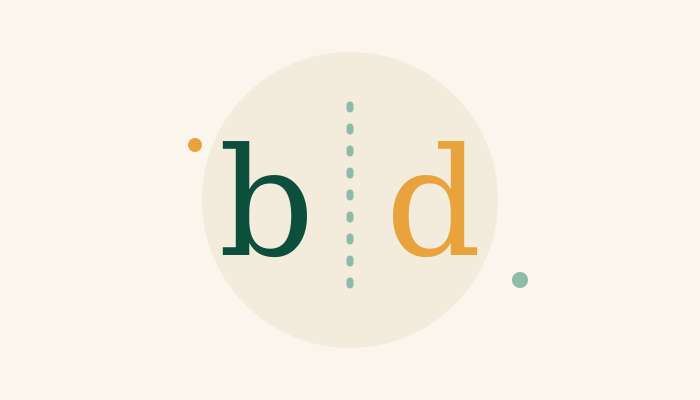
Confusing the letters b and d while reading and writing is common in preschoolers and normal until about six and a half to seven years of age. It is often taken as a sign of dyslexia, but on its own it is not. Simple, consistent correction at home and school usually resolves it before it hinders learning.
Why do children mix up b and d?
The difficulty comes from how our brains interpret visual signals. A brain’s default assumption is that similar shapes represent the same underlying object, which is usually a helpful shortcut: a cup is a cup whichever way it faces. To a young child, b and d look like the same shape seen from different angles, and the idea that the viewing angle changes the identity of a letter takes real processing effort to accept.
There is a second, simpler reason, and a webinar on letter reversals I sat in on recently kept coming back to it: many children were never taught, step by step, how a b is built differently from a d. The two letters are made of the same two pieces, a straight line and a curve, and the only thing separating them is which side the curve sits on. Nothing in a child’s earlier life prepares them for a rule like that. It has to be shown directly, not left to be guessed from copying. Two habits make reversals more likely, and neither is a red flag on its own: asking a child to write letters before they can reliably recognise and name them, and introducing lower-case letters before the capitals are solid.
Dyslexia can be one reason for persistent reversals, but it is not the only one. Around 8 out of 10 people with dyslexia have difficulty with directional knowledge, which produces the left-right and up-down flipping seen in b/d, p/q, and 6/9. When dyslexia is behind the reversals, the child usually struggles with other things too: letter and number sequencing, poor and inconsistent spelling, and simple maths. A child who only flips b and d, and does so before age seven, is most likely just being a normal young reader. If the reversals persist alongside those other signs, it is worth checking the broader early indicators of learning difficulty and the facts about dyslexia.
Reversals before age seven are development, not diagnosis.
Five ways to help at home
1. Give each letter a picture
The easiest explanation is a visual one: b has a belly, d has a diaper. Draw it, laugh about it, and repeat it every time you teach the letters or your child slips. Gradually the picture does the remembering for them, and the correct letter starts appearing in their spellings.
2. Teach the “b hand”
Try this simple elastic-band activity. Sit with your child and put a band on their left hand, without mentioning left or right. Ask them to make a b shape with the fingers of that hand. Now show flashcards or words starting with b. The child begins to visualise the b shape and recognises it wherever it appears. Repeat the band activity for two to three weeks; after that the hand knows its job without the band. It is simply their b hand.
3. Use one-letter-at-a-time worksheets
Print worksheets where your child circles only the letter b, or colours only the b shapes. The one rule that matters: work on a single letter at a time. Do not mix b and d in the same activity; the whole point is to let one letter become automatic before its mirror twin re-enters the room.
4. Build the letter before writing it
Let your child assemble the letter before drawing it. Wooden or magnetic pieces, or a used gift card cut into a curve and a line, arranged piece by piece, big line, little line, big curve, little curve, until the letter sits there on the table. Then a simple three-step routine on a small chalkboard: trace the letter with a wet sponge, dry it with a paper towel, then write it with chalk. Five minutes of that before paper writing builds motor memory that a worksheet alone cannot. No special equipment needed; a finger tracing shapes in a tray of rice does the same job.
5. Anchor each letter to one your child never confuses
d is what some teachers call a magic C letter: trace a C, then close it up into a d. Since d also shows up in print about three times as often as b, it makes sense to anchor d first and let b follow. For b, borrow from h: down, then up and over, the same motion. Most children never reverse h, because it has no mirror twin, so building b from that same movement gives the hand something solid to hold on to.
However you practise, keep the correction calm. Children who reverse letters usually do not notice they are doing it, so pointing it out in the moment is rarely enough; they need the correct pattern shown again and a little daily practice. A no-eraser rule helps too: draw a single line through the slip and keep going. It takes the sting out of a backwards letter and keeps a child writing instead of freezing up.
For a lovely demonstration of this kind of correction in practice, watch reading expert Linda Farrell working with Aiko, a second-grader, in this video.
Frequently asked questions
My 5-year-old writes b as d. Should I worry?
No. At five, reversals are developmentally normal. Use the tricks above, keep it playful, and expect the confusion to fade by around age seven.
When do reversals suggest something more?
When they persist past seven despite consistent correction, or come with trouble sequencing letters and numbers, inconsistent spelling, and difficulty with simple maths. That cluster deserves a proper assessment rather than more worksheets. For a child in the primary grades who is still reversing letters or numbers regularly, a simple handwriting screener is a sensible first step before assuming anything more serious is going on.
Dr. V.S. Gayathri is a Dyslexia Therapist, an Orton-Gillingham trained literacy specialist, and the founder of Flourishing Kids. She has delivered over 4,000 hours of one-to-one reading and spelling intervention, helping children across multiple countries build stronger literacy skills. If your child’s letter reversals are persisting, get in touch for a free 15-minute conversation.