The history of English writing: why our spelling is the way it is
By Dr. V.S. Gayathri ·
writing learning
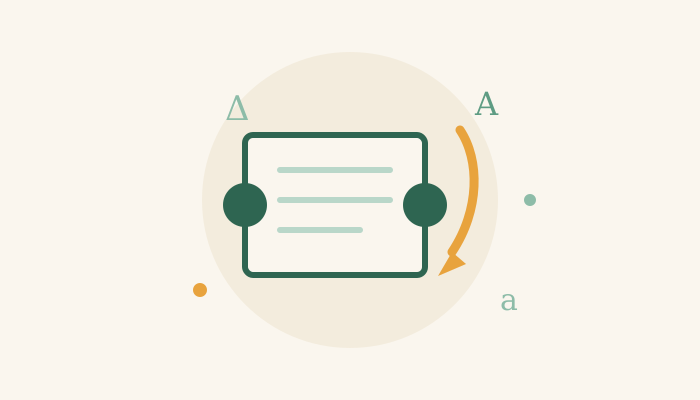
English writing is a stack of borrowed systems: a Phoenician consonant alphabet, Greek vowels, Roman letterforms, Anglo-Saxon everyday words, and floods of French, Latin and Greek vocabulary. Every spelling quirk your child battles, silent letters, c and k making one sound, “rough” and “thought”, has a historical reason. Knowing the layers makes the language teachable.
“The English language is a work in progress. Have fun with it,” said Jonathan Culver. Of the world’s thousands of languages, English has become one of the most spoken, and its writing carries the fingerprints of everyone who ever conquered, converted or traded with Britain. Here is the story in brief, and why it matters to a struggling reader at the end.
Before alphabets: pictures on stone
The earliest writing was signs and images carved on stone, petroglyphs, found all over the world. Three of their habits survive in everything we write today: they simplified (message over aesthetics), they ran in a sequence (linear order, like our lines of text), and they relied on a shared understanding of what each sign meant, exactly like words. As communication grew more complex, the signs evolved, generation by generation.
The great eras of writing
The Sumerians, about 5,000 years ago, developed the first adequate phonetic writing system: a syllabary (symbols for vowel-consonant combinations like ab, ac), pressed into clay with wedge-shaped stamps, called cuneiform. The code was so well built that Sumerian could be decoded thousands of years later.
The Egyptians, around 3000 BC, developed hieroglyphics (“sacred inscriptions”): a mix of pictograms, ideographs (signs with abstract meanings) and sound-pictures, the precursors of a phonetic system where a sign signifies a sound rather than a meaning. With the invention of paper, writing escaped the priests and the wealthy and reached ordinary people.
The Phoenicians, skilled sailors, built an alphabet of 22 characters for consonant sounds only. An English sentence in their style would read: Cn Jm rd tht bk? Like the Egyptians, they made their sound-symbol pairs from the initial sounds of familiar objects.
The Greeks, great borrowers, adopted the Phoenician letters, and the word “alphabet” itself comes from the first two: aleph + beth. They took 19 Phoenician consonant symbols, invented the vowels their language needed, and by 400 BC had a 24-character alphabet running left to right, the direction we still follow. Everything was capitals, though, with no spaces, commas or full stops.
The Etruscans, powerful in Italy before Rome, used 26 letters: 22 Phoenician plus 4 Greek. Rather than discard letters they did not need, they kept duplicates, which is why some sounds still have more than one letter: the c and k of can and kin.
The Romans adopted 21 Etruscan letters and gave the alphabet its modern face: capital and uncial (half-lowercase) forms, punctuation, the letter G for the hard /g/ of goat, and thick-and-thin strokes finished with serifs. Roman soldiers carried this alphabet to Britain.
The Celts were Britain’s earlier inhabitants, speaking Gaelic, a language quite distinct from English and still spoken in parts of Ireland, Wales and Scotland.
The Angles and Saxons are where English truly begins. After the 5th-century invasion by three Germanic tribes, the Jutes, Saxons and Angles, the Celtic speakers were pushed west and north, and Engla-land, “the land of the Angles”, spoke Englisc. Old English ran from roughly 450 to 1100 AD: a simple, concrete language of everyday objects and actions, some of it still readable today: cwen (queen), hus (house), cyning (king).
The Christian monks arrived to convert the Anglo-Saxons and changed literacy itself: they brought the Roman alphabet, plus Latin, Greek, Hebrew and Arabic vocabulary. Exotic words like pepper, orange and oyster entered English; religious words like disciple, shrine and priest arrived; and old Angle words like heaven, hell and God took on new meanings.
The Vikings brought Old Norse. Some of its words replaced Old English (husband, leg, skull, sky); others settled in alongside, with shades of difference: nay/no, scatter/shatter, wake/watch.
The Normans invaded in 1066, and for the next 300 years no king of England spoke English. Between 1100 and 1500, more than 10,000 French words entered the vocabulary, three-quarters of them still in use, plus thousands from scholarly Latin and the Dutch and Low German trades. England became bilingual and two-tiered: the peasants raised the swine, sheep and cows (Anglo-Saxon words); the aristocrats ate the pork, mutton and beef (French ones).
Middle English (1100 to 1500) put the changed spoken language on paper, in strong regional dialects; the London dialect that Geoffrey Chaucer wrote in eventually became the standard. Early Modern English followed in the 16th and 17th centuries, reaching its richness in Shakespeare, who alone coined some 2,000 words and phrases (“in my mind’s eye”, “in a pickle”), and in the King James Bible. Old plurals like shoen gave way to shoes, leaving relics like children and oxen, and family names like Brooks and Shepherd took root.
Today’s English: a language in three layers
Modern English is alphabetic and phonetic, but above all it is layered, and the layers explain the spelling:
- The Anglo-Saxon layer gives us the short, everyday one- and two-syllable words, extended by compounding and affixes (-ed, -ing, -able). Its irregulars, like thought and rough, are the famous “learned words” that simply must be taught.
- The Latin layer gives multisyllable words built on roots that cannot stand alone, always affixed, never compounded, with one accented syllable and the soft schwa sound in the rest (servant, hospital). More than half of today’s words, especially in law, government and religion, come from Latin.
- The Greek layer gives the words of science, technology and theatre, usually compounds of equal-stress roots (tele/scope, hemi/sphere), with three special patterns: ph = /f/, ch = /k/, y = /i/. Only about a hundred Greek roots need actually be learned; context does the rest.
English spelling is not chaos. It is three languages politely sharing one alphabet, and a child can be taught which one they are looking at.
This is why the history matters to a parent of a struggling reader. A child taught “English spelling is full of exceptions, memorise them” is being set up to fail. A child taught the layers, this word is Greek so ch says /k/, this one is Anglo-Saxon so it compounds, learns a system. That is exactly how structured literacy approaches like Orton-Gillingham teach spelling: by origin and pattern, not by rote. The language has rules; they are just a thousand years deep.
Dr. V.S. Gayathri is a Dyslexia Therapist, an Orton-Gillingham trained literacy specialist, and the founder of Flourishing Kids. She has delivered over 4,000 hours of one-to-one reading and spelling intervention, helping children across multiple countries build stronger literacy skills. teaching English as the layered system it really is. If spelling feels like memorising chaos to your child, get in touch for a free 15-minute conversation.