What progress looks like before reading becomes fluent
By Dr. V.S. Gayathri ·
dyslexia reading
Before reading gets faster, four things change: your child pauses at a hard word instead of guessing, fixes their own mistakes, uses a taught rule without being asked, and reads words nobody taught them. These signs appear in the first month or two of dyslexia intervention. Speed comes last, usually months later, and that order is normal.
Why speed is the last thing to change
Parents watch for one thing: is my child reading faster? I understand it. Speed is easy to see, and it is what the school measures. But speed is the last thing to change, and if you wait for it you will miss the signs that come first and that predict it.
Here is why. A child with dyslexia who has been guessing words from their shape and first letter has been doing that for years. Intervention teaches a different way through a word: say each sound, blend them, check that it makes sense. Done properly, that is slower than guessing at first. The guess was instant and often wrong. The new way is deliberate and usually right. Accuracy improves while speed stays flat, or even dips for a few weeks. Only after a pattern has been read correctly many times does it become automatic, and automatic is what fast reading is made of. The research says the same. In one of the most cited intervention studies, children with severe dyslexia made large gains in reading accuracy and comprehension while their reading rate stayed well behind long after the programme ended.
So in the early months I am not looking at the clock. I am looking at what the child does when a word is hard.
Sign one: the guess turns into a pause
The first change is small and easy to miss. Your child reaches a word they do not know and, instead of saying the first thing that comes to mind, they stop. Maybe a finger goes under the first letter. Maybe they say the first sound and wait. That pause is the old habit losing its grip.
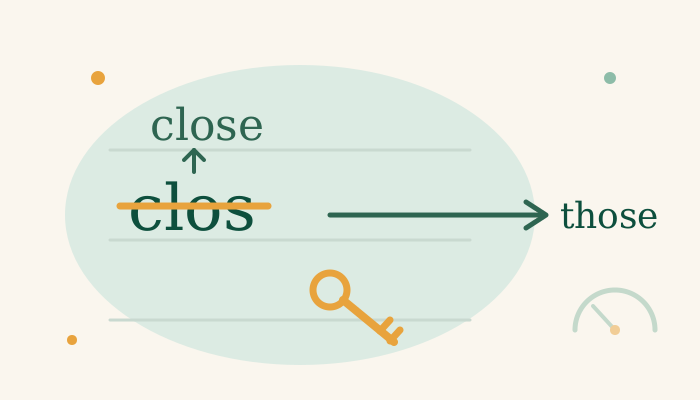
In my sessions I never supply the answer. If a child reads “close” as “clos”, I ask what the e at the end is doing. Early on, the child needs the question. A few weeks in, I see them read “clos”, stop, look at the end of the word, and say “close” before I have said anything. That is the moment I write down. They have gone from being corrected to correcting themselves. The standard progress-monitoring tools agree with me: a word the child mispronounces and then self-corrects within three seconds is scored as read correctly, not as an error.
A related sign is that the child starts saying “I don’t know” instead of bluffing. One teenager I work with will not say he has understood a rule if he has only half understood it. His mother told me this in our first monthly call, and it is one of the reasons he moves quickly. An honest “I don’t know” means the child has stopped performing reading and started doing it.
Sign two: the rule shows up where you didn’t put it
Every rule I teach is taught in one place, with one set of words, and then it has to travel. The sign of progress is when it travels on its own.
A six-year-old I work with was writing a dictation sentence that ended with “glass”. He wrote “glas”, looked at it, added the second s, and said “I put two”. Nobody had prompted him. We had learned the doubling rule for f, l and s a few weeks before, in a different session, with different words. The rule had moved from my whiteboard into his hand.
With older children the rule travels in a different direction: into a question they ask themselves. In the first weeks, I ask “will it be c or k?” at every word that needs it. Later I hear the child mutter “c or k… k, because of the i” before writing. The question has become theirs.
Watch for this at home. When your child, doing homework, pauses before a word and says something like “it’s a long sound, so it needs the e”, that is intervention working, even if next week’s spelling test is still poor.
Sign three: each new pattern takes less time than the last
This is the best predictor I know, and no test measures it.
The first long vowel pattern I teach takes weeks. The child has to learn not just the spellings but the whole routine: the key sentence that holds every spelling of one sound, the sorting table, the position rules that decide which spelling to try first, the story where they hunt for the words. By the fourth or fifth vowel the routine is familiar and the child is only learning the content.
A teenager I work with took most of a month on his first vowel pattern. His fifth, the long i sound with its five spellings, took two sessions. When I asked why it had felt easy, he said it was “just pattern identification now”. He was right. He had not simply learned five spellings. He had learned how to learn a spelling pattern, and that is what he will use on every pattern after this one, including the ones we never get to. Linnea Ehri, whose work on orthographic mapping describes how words get stored for instant reading, shows the same thing happening in the brain: once the sound-to-spelling connections are secure, the child stores whole chunks and syllables, not one word at a time.
If your child’s provider gives you a monthly update, ask how long the latest concept took compared with the first one. Shrinking is progress.
Sign four: taught patterns turn up in untaught words
The last early sign is the one that turns into fluency. Your child reads a word they have never seen in a session, correctly, by using something they were taught for a different word.
I taught one student to split a long word by finding the vowels and dividing between them, using “napkin” and “plastic”. Weeks later he split “porridge” and “ginger” himself, two words we had never touched, and read them. Another child, taught that igh gives one sound in “night” and “light”, met “frightened” in a story and did not blink. The pattern had become a tool, not a memory of a particular word.
This is also why I use decodable stories rather than word lists for reading practice. A list tells me whether the child remembers the words we did. A story full of the pattern in words we did not do tells me whether the pattern is theirs. Reading researchers call this self-teaching: every unfamiliar word a child decodes correctly on their own adds that word to memory, which is how the stock of words read at a glance is built, one correct attempt at a time.
Parents notice this one outside the session: the shop sign, the message on your phone, the back of the cereal box. It usually comes in the first term, and I describe that stage in how long does dyslexia intervention take.
Watch for the pause, the self-correction, the rule used unprompted, and the untaught word read correctly. Speed follows those four. It never leads them.
What I check every month, and how
I do not rely on a feeling that things are better. At the end of each month I check three things directly and tell the parent what I found.
First, accuracy on words that carry the patterns we have taught, read cold, including words the child has not met in a session. Second, dictation of those same patterns inside sentences, because spelling lags reading and shows me what is truly secure. Third, what the child does at a hard word: guess, freeze, or work through it. I write the errors down, because the type of error matters more than the count. A child who reads “stable” as “stab-le” is one question away from right. A child who reads it as “star” is still guessing.
Reading speed is on the list too, but it is last, and I treat it as a trailing measure. Structured literacy programmes are built this way on purpose: accurate decoding first, then automaticity through practice, then fluency. Jan Hasbrouck, whose oral reading norms most schools use, puts it plainly: below about 95 percent accuracy comprehension suffers, and reading fast is not the same as reading fluently. If you want to see what the sessions themselves are built from, what happens in online dyslexia intervention walks through one minute by minute.
What does not count yet
Three things that parents often read as “no progress” are not.
School marks. The test paper sits at the top of a skill that is being rebuilt from the bottom, and marks move last. I have written about this separately in why school marks don’t improve as soon as dyslexia intervention starts.
Spelling in free writing. A child can spell “shell” correctly in dictation for a month before it appears in a story they write themselves, because free writing asks the brain to do five things at once and spelling is the first thing dropped. Dictation accuracy is the earlier, truer signal.
A bad day. Recently a child arrived at a session exhausted, refused the letter cards, and could barely sit. We did ten minutes of writing, some jumping jacks, a short video, and stopped early at his mother’s request. Nothing was lost. A tired child reading badly on a weekday evening tells you about the evening, not about the programme.
What the signs look like in a teenager
With an older child the early signs look slightly different, because the gap is larger and the guessing habit is older. The pause shows up as a frown and a re-read. Self-correction comes with an “oh” and an eye-roll. The rule used unprompted often appears in a subject that is not English: a biology term split into syllables before it is written, a mnemonic built without being asked. Teenagers will also tell you directly, if you ask, whether a rule feels secure. Take their word for it. In my experience they under-claim rather than over-claim.
When the signs do not come
If two months of regular sessions have passed and you see none of these, say so. It is not rude and it is not a failure. It is the information the therapist needs. The usual reasons are frequency (once a week is too little for the method to hold), a gap that is larger than it first looked, or something alongside the dyslexia, such as attention or working memory, that needs its own support. The dyslexia or ADHD post explains how I tell those apart. Every family at Flourishing Kids starts with a Reading & Spelling Snapshot, an informal reading and spelling assessment done live, so that we know the starting point and can tell real progress from a good day.
Frequently asked questions
How soon should I see these signs?
The pause and the first self-corrections usually appear within the first month of sessions at three to four a week. Rules used unprompted and transfer to new words follow over the first term. Speed is a second-term change for most children, and later for older ones.
Should I time my child’s reading at home?
Not in the early months. A timer makes a child who is learning to blend go back to guessing, because guessing is faster. If you want something to track, keep a note of words your child reads correctly that you know were never taught, and words they self-correct. Bring the list to the monthly call.
My child reads more slowly now than before intervention. Is that normal?
Often, yes, and briefly. A child who guessed quickly and wrongly is now working through words deliberately. Accuracy goes up before speed does. If accuracy is also not improving after six to eight weeks, raise it with the therapist.
Is accurate but slow reading really progress?
Yes. Accurate decoding is what automatic reading is built from. Every word read correctly by working through it is a word that will be read on sight sooner. Fast and wrong does not lead anywhere.
Dr. V.S. Gayathri is a Dyslexia Therapist, an Orton-Gillingham trained literacy specialist, and the founder of Flourishing Kids. She has delivered over 4,000 hours of one-to-one reading and spelling intervention, helping children across multiple countries build stronger literacy skills. If you would like to know what progress would look like for your own child, get in touch for a free 15-minute conversation.