How to teach a child with dyslexia to read
By Dr. V.S. Gayathri ·
dyslexia reading
A child with dyslexia learns to read through structured literacy: explicit, step-by-step teaching of how letters map to sounds, practised with sight, sound and movement together until each skill is automatic. More reading practice alone does not work, because the child cannot yet decode. With the right teaching, almost every child with dyslexia learns to read well.
Why hasn’t reading clicked for your child yet?
Speech is natural; reading is not. Every human brain wires itself for spoken language, but print is an invention, and every brain has to be taught the code that connects letters to sounds. Most children piece the code together from classroom phonics and exposure. A child with dyslexia cannot piece it together from exposure, because the very skill exposure relies on, hearing and mapping the individual sounds inside words, is the skill dyslexia affects.
So the child copes. She guesses from the first letter. She reads the picture instead of the word. She memorises the shape of whole words, and that trick carries her until age seven or eight, when the words become too many and too long to memorise. That is usually when parents land on a search like this one.
Two things are worth saying plainly. Your child is not lazy, and this is not a result of anything you did or did not do at home. Reading failure in dyslexia is a teaching mismatch, not a character flaw. The fix is a different kind of teaching.
What kind of teaching actually works?
The approach with decades of evidence behind it is called structured literacy, a term coined by the International Dyslexia Association. It is explicit: every letter-sound relationship and spelling rule is taught directly, nothing is left for the child to infer. It is systematic and cumulative: skills come in a planned order, each one resting on skills already mastered. It is multisensory: the child sees the pattern, says the sound, and writes it in the same activity, because engaging several senses at once builds memory that sticks. And it is diagnostic: the teacher checks what the child has actually mastered and adjusts the next lesson to match.
The best-known form of structured literacy is the Orton-Gillingham approach, which is what I use in my own practice. The label matters less than the properties. If teaching is explicit, systematic, multisensory and paced by mastery, it is the right kind.
What are the steps, in order?
Whatever the programme is called, the sequence underneath is the same.
- Train the ear first. Before letters, the child needs to hear the sounds inside words: rhyming, clapping syllables, answering “what is the first sound in mat?”. This is phonemic awareness, and decades of reading research place it at the foundation everything else stands on.
- Teach letter-sound links directly. A few at a time, never in a rush. The child sees s, says /s/, and writes it while saying it, until the link fires without effort.
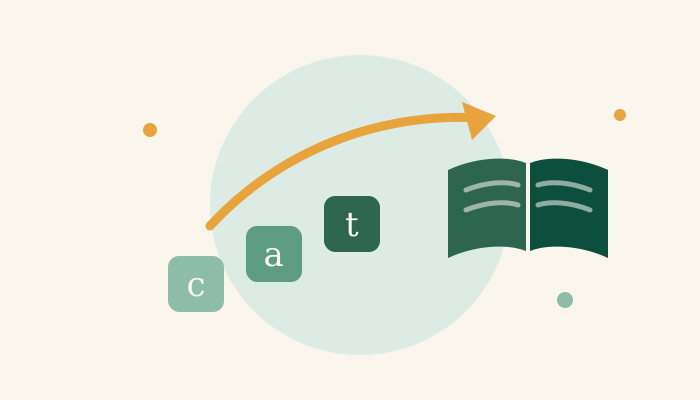
- Blend sounds into words. With a handful of letters the child starts pushing sounds together: /c/ /a/ /t/ becomes cat. Letter tiles and cards make this physical and visible.
- Read text built only from what has been taught. Decodable text uses just the patterns the child owns, so every sentence is achievable. Success is designed in, and guessing has nowhere to hide.
- Spell everything you read. Reading and spelling are two sides of the same code. Spelling the same patterns the child is reading anchors them far more deeply than reading alone.
- Build fluency, then comprehension. Once decoding is accurate, rereading familiar text builds speed and expression, and comprehension finally gets room to grow, because the child’s effort is no longer spent on sounding out.
The order matters more than the pace. A child who has mastered three steps slowly is far better placed than a child who was hurried through six.
More reading practice does not teach a child with dyslexia to read. Teaching the code does, one mastered step at a time.
What can you do at home?
You do not need to become a therapist. The structured teaching is the specialist’s job; your job is practice, confidence and warmth. Those compound.
- Ten minutes a day. A short daily session beats an hour on Sunday. Dyslexic brains need many small repetitions, not occasional big ones.
- Play with sounds anywhere. In the car, at dinner: “I spy something starting with /b/”, rhyming chains, clapping the syllables in family names. No materials needed.
- Trace and say. Write a letter large, and have your child trace it in a tray of sand, rice or salt while saying its sound. Touch and movement do real work here.
- Keep reading aloud to your child. Whatever their age. It feeds vocabulary and comprehension while decoding catches up, and audiobooks count.
- Praise the effort, at the word level. “You worked out that whole word yourself” lands better than a general “well done”. Struggling readers are exhausted readers; keep home reading light and safe.
What should you avoid?
A few well-meant habits quietly make things worse.
- Waiting. “He will catch up” and “girls read earlier, give it time” cost the one thing that shortens intervention: an early start. The gap between a struggling reader and the class widens every term.
- Prompting guesses. “Look at the picture” and “what would make sense here?” train the exact habit structured teaching has to undo. Prompt with sounds instead: “say each sound, then push them together”.
- Memorising spelling lists. Words crammed for Friday’s test are gone by Monday, because nothing connected them to sounds. Fewer words, taught by pattern, hold.
- More of the same tuition. Repeating schoolwork slower and louder does not rebuild the foundation. If two years of tuition have not moved the needle, the method is the problem, not your child.
- Books that are too hard. A page where your child fails on every second word teaches only dread. Easy books, reread happily, do more good.
How long does it take?
Honest answer: months and years, not weeks, and the confidence returns long before the reading catches up. Across 4,000+ hours of one-to-one intervention, the pattern I see is steady. Within the first month, most children read their first sentence built entirely from patterns they own, often the first success they have had with print in years, and something in their posture changes. Measurable decoding gains follow over three to six months. Closing a multi-year gap typically takes 12 to 24 months of consistent structured teaching, paced by mastery rather than by a calendar.
The single biggest lever on that timeline is how early you start. A five-year-old showing early signs of literacy difficulty has a small gap to close; a ten-year-old has years of lost practice and lost confidence stacked on top. Earlier is easier, but later still works.
When should a specialist take over?
Home support is enough when a child is slightly behind and moving. Bring in a specialist when the child is a year or more behind classmates, when school phonics plus your home practice has produced no movement in six months, or when reading time reliably ends in tears, anger or avoidance. Those are signs the foundation itself needs rebuilding, and that is one-to-one work.
You do not need a formal diagnosis to begin. An informal assessment can establish in an hour or two whether your child’s difficulties fit the dyslexia pattern and what kind of support would help. And this work no longer depends on where you live: structured one-to-one intervention works fully online, and at Flourishing Kids children across India, the UAE, Oman, Singapore, Australia, the UK and the US learn this way every week.
Frequently asked questions
Can a child with dyslexia really learn to read normally?
Yes. Dyslexia is lifelong, but reading failure is not. With structured, explicit teaching the brain builds the pathways it did not build on its own, and most children reach functional, comfortable reading. Spelling often stays effortful for longer, and that is normal.
Should I wait for a formal diagnosis before starting?
No. In India a formal SpLD assessment is usually only possible from around age eight, and children should not lose those years. Structured literacy helps regardless of the eventual label, and an informal assessment can tell you within hours whether the pattern fits.
My child is twelve. Is it too late?
No. The same teaching works at any age, and older children often move through the early steps faster because their oral language is stronger. What waiting costs is confidence, not ability. Start where the gaps are, however old the child is.
Dr. V.S. Gayathri is a Dyslexia Therapist, an Orton-Gillingham trained literacy specialist, and the founder of Flourishing Kids. She has delivered over 4,000 hours of one-to-one reading and spelling intervention, helping children across multiple countries build stronger literacy skills. If your child is struggling to read, get in touch for a free 15-minute conversation about what would help.