What is multisensory teaching and why does it work?
By Dr. V.S. Gayathri ·
learning reading
Multisensory teaching engages more than one sense at a time: a child sees a letter pattern, says its sound, hears it, traces it, and moves with it. For children who struggle to learn to read, research from the National Institute of Child Health and Human Development found this the most effective teaching method, because it gives the brain several pathways to the same information.
Effective communication sits at the heart of good teaching, and communication can reach a learner through a single sense (say, hearing alone) or through several at once: hearing, sight, and movement together. Teaching through multiple senses gives the learner additional routes for information to arrive, and additional routes for it to be recalled later.
One study found multisensory methods notably beneficial in elementary language education for children with speech and language disorders. These methods are used most of all with children with dyslexia, which affects an estimated 10 to 15 percent of people and about 80 percent of those identified with a learning disability.
What is multisensory teaching?
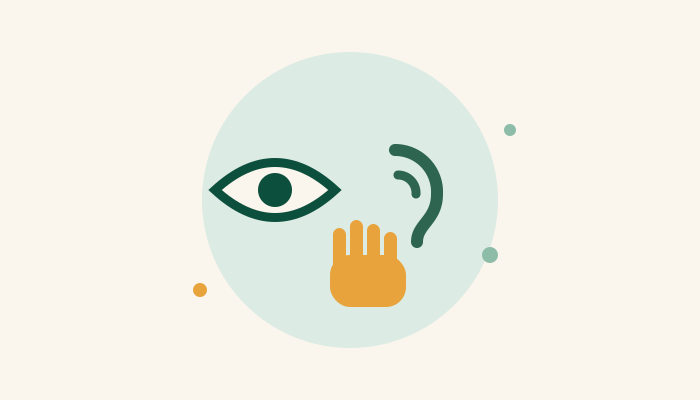
It is teaching that uses the brain’s learning pathways together, simultaneously or in sequence: visual, auditory, kinesthetic, tactile, and oral. In a classic lesson, most children rely on sight (text and pictures) and hearing (the teacher’s voice). Multisensory teaching widens that. Not every lesson uses all five senses, but in most multisensory lessons the child engages with the material in more than one way at once.
That engagement lets students use their senses to gather information, link it to concepts they already know, follow the logic of a problem, practise problem-solving and non-verbal reasoning, and see relationships between ideas.
This is also the “multisensory” in multisensory structured literacy: it is one of the four pillars of the Orton-Gillingham approach used in dyslexia intervention worldwide.
How does it benefit learners?
Improved focus. When the brain is stimulated in more than one way, attention has fewer places to escape to. A child who must do something while listening to instructions and looking at information has little room for a concentration lapse, and the effort feels like play rather than discipline.
Better retention. With more than one sense processing the information, memory has backup copies. Even if a child forgets what they heard, they remember what they saw or what their hand did. Teachers sometimes call it a 360-degree approach.
A pathway for every learner. Some children grasp a concept by hearing it explained; others need to see it on paper; others learn by physically doing. Multisensory teaching does not gamble on which kind of child is sitting in front of you. Every child gets a route in.
Stronger learning overall. Multisensory environments exercise fine motor skills, body memory, and the connections between sensation and meaning. Children taught this way can conceptualise and then apply information, rather than just watch and listen, and the practice strengthens listening, critical thinking, vision, tactile recognition and conceptualisation along the way.
When the hand, the eye and the ear all learn the same letter, forgetting takes real effort.
What are the main multisensory techniques?
Visual techniques
Text and pictures on paper, posters, flashcards or screens; colour for highlighting; graphic organisers and passage outlines; art, images and video. A favourite of mine for beginners is air writing: the child writes letters in the air while saying the sound aloud. Diction improves, pronunciation settles, and the letter shape gets stored in the arm as well as the eye. It works best in the early grades, right when children are first learning letters and words.
Auditory and oral techniques
Audiobooks and recorded text, peer-assisted and paired reading, group discussion, computerised text reading; video with audio; and any form of music, song, rhyme, speech or language game. For children who resist print, the ear is often the friendliest door in.
Tactile techniques
Techniques that work through touch: sand trays for tracing letters, finger paints, puzzles and educational objects that build fine motor skills; clay and sculpting materials; and manipulatives, the small counting objects that make number values something a child can hold while learning maths.
Kinesthetic techniques
Techniques that work through body movement, fine and gross. Jumping rope, clapping and moving objects while counting or singing concept songs; dance; and large-movement learning games such as quizzes and flashcard races.
How can parents use this at home?
You do not need special training to make homework multisensory. Have your child spell a word aloud while tracing it in a tray of rice. Clap the syllables of new words. Let them explain a lesson back to you while walking around the room. Each added sense is another hook for the memory. If your child struggles despite this kind of support, that is a signal worth investigating; the early indicators of learning difficulty are a good place to start.
Dr. V.S. Gayathri is a Dyslexia Therapist, an Orton-Gillingham trained literacy specialist, and the founder of Flourishing Kids. She has delivered over 4,000 hours of one-to-one reading and spelling intervention, helping children across multiple countries build stronger literacy skills. To ask whether this approach would help your child, get in touch for a free 15-minute conversation.