How long does dyslexia intervention take? What to expect
By Dr. V.S. Gayathri ·
dyslexia parenting
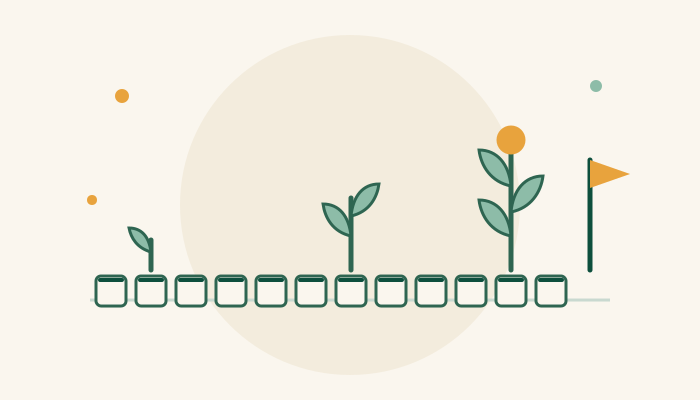
Dyslexia intervention usually takes 6 to 18 months of one-to-one sessions, three to four times a week. Most children show early changes within the first month: more confidence, fewer guesses, the first sounds held securely. Lasting change in reading and spelling takes longer, and the pace is set by what the child has mastered, not by the calendar.
Why there is no single number
Parents ask me this question in the first phone call, and I understand why. You are weighing time, money, and your child’s patience, and you want to know what you are signing up for. I will give you the honest range, and then I will explain what moves a child towards the short end or the long end of it, because that is the part you can actually act on.
The range is wide because children arrive in very different places. A seven-year-old who knows most letter sounds but guesses whole words from their shape needs a different programme from a fourteen-year-old who has reached secondary school without ever being taught how long vowels work. Both can be helped. They will not take the same amount of time. If you want to understand the condition itself before reading about timelines, start with all about dyslexia.
What changes in the first month
The first month is about the foundations and about trust. In most programmes we are working on single letter sounds, the short vowels, and simple three-letter words, even with older children. Parents of older children sometimes worry that this is a step backwards. It is not. A child who reads “napkin” by guessing cannot read “contribution” by guessing, and the only way to stop guessing is to make the sounds automatic. Once the basics are strong, there is space in the brain for the newer concepts.
By the end of month one I expect to see three things. The child says the sounds together rather than reading the first letter and guessing. The child corrects their own mistakes when prompted with a question instead of waiting to be told. And the child is less afraid of the page. A mother once told me that her son, who had been saying “Mummy, this is very hard” about everything, had started asking for the reading game. That is month one working.
Marks at school usually do not change yet. I tell parents this plainly so that nobody panics in week six. The reading is being rebuilt from the bottom, and the test paper sits at the top.
What changes in the first term
Over the first three to four months the child builds a stock of rules that explain most of English spelling: when to write ck and when to write k, why f, l, and s double at the end of a short word, what the silent e does, how to split a long word into syllables and read each one. Each rule is taught once, then revisited inside new work for weeks. I do not wait for a rule to be perfect before moving on. If it holds about eight times in ten, we go forward and keep coming back to it, the way you keep coming back to multiplication tables.
This is the stage where parents notice the child reading things in the world: a shop sign, a message on a phone, the back of a cereal box. Spelling in dictation improves before spelling in free writing does, which is normal. Reading aloud gets steadier, though not necessarily faster yet. Speed comes last, and pushing for it early makes the guessing come back.
Progress in dyslexia intervention is measured in what the child can now do without help, not in how many weeks have passed.
What changes by the end of the first year
By twelve months, most children I work with are reading grade-level text with reasonable accuracy, spelling the common patterns reliably, and reading on their own for pleasure, which is the result that matters most and the one I cannot teach directly. Comprehension work, which I deliberately leave until decoding is secure, is well underway. For older children, the session has usually widened to include study skills such as mind maps, mnemonics, and flashcards, because an exam tests not only whether you understood a concept but whether you can retrieve it and write it down under pressure.
Some children are done at this point. Others, especially those who started with a gap of several years, continue into a second year at a lighter frequency. The decision is made together, parent and therapist, from what the child can now do independently.
What sets the pace
Five things decide whether a child lands nearer six months or nearer eighteen.
- How far behind the child started. A gap of one year closes faster than a gap of four. This is the biggest factor and the one you have least control over, which is why starting early matters so much. The signs of dyslexia by age post helps you judge where your child is.
- How often sessions happen. Three to four sessions a week is the pattern I recommend, and the children on it progress noticeably faster than children I see twice a week. The method is cumulative, and a week between sessions is long enough for a new skill to fade.
- Whether the child comes regularly. Missed weeks for holidays, exams, and illness are normal and expected. A month-long gap, though, usually costs two or three sessions of review on return.
- What happens at home. Ten minutes of dictation a few evenings a week, done the way we do it in class, makes a visible difference. The important part is saying the same thing I say: “blend the sounds and read the word, don’t guess.” When parent and therapist speak the same language, the child understands quickly what is expected.
- Whether something else is also going on. Attention difficulties, a speech delay, or weak working memory do not stop intervention from working, but they slow it. In those cases I keep the sessions going and bring in the right specialist alongside, rather than pausing reading while we wait for other reports. The dyslexia or ADHD post explains how I tell the two apart when they overlap.
How do we know when it is done?
A programme ends when the child can do three things without me: read an unfamiliar word by working through its sounds and syllables, spell the common patterns correctly in their own writing, and pick up a book at their level and keep going when a word is hard. I check these directly, not through a test score. When they hold for a few weeks, we reduce the frequency, then stop.
What a programme does not do is remove dyslexia. The child will always process print a little differently, and may always read a little more slowly than a classmate. What changes is that reading stops being a wall. That is the goal, and it is reachable for nearly every child who is given enough time and the right teaching.
A word about promises
Be careful of anyone who gives you a fixed number of weeks before meeting your child. I cannot tell you how long your child will take until I have listened to them read and seen where it breaks down. That is why every programme at Flourishing Kids starts with a Reading & Spelling Snapshot, an informal reading and spelling assessment done live, one-to-one. After it, I can tell you where we are starting, what the first months will contain, and a realistic range for your child rather than a general one. If you want to see what the sessions themselves look like before deciding, read what happens in online dyslexia intervention.
Frequently asked questions
Can dyslexia intervention be finished in three months?
Rarely, and only for a child with a small, specific gap caught very early. For most children three months is the point at which the foundations are secure and the real spelling and reading work begins. Anyone promising a complete fix in a few weeks is describing something other than structured literacy intervention.
Does an older child take longer?
Usually, because the gap is larger and old guessing habits are well practised. But older children also understand rules faster and can be told why a rule exists, so the early months often move quickly. A teenager who starts at the beginning and keeps a steady pace can reach grade-level reading within a year.
What if we need to stop for a while?
Short breaks for exams and holidays are fine; I plan around them. A gap of a month or more means a few sessions of review on return. If you need to pause, tell me early so we can leave the child at a stable point rather than halfway through a new rule.
How will I know it is working?
Within a month you should see fewer guesses and more self-correction. Within a term, the child should be reading things in the world unprompted and spelling the patterns we have taught in dictation. We review progress together every month, and I will always tell you plainly if something is not moving.
Dr. V.S. Gayathri is a Dyslexia Therapist, an Orton-Gillingham trained literacy specialist, and the founder of Flourishing Kids. She has delivered over 4,000 hours of one-to-one reading and spelling intervention, helping children across multiple countries build stronger literacy skills. If you would like a realistic timeline for your own child, get in touch for a free 15-minute conversation.