Why an older child with dyslexia starts at vowel sounds again
By Dr. V.S. Gayathri ·
dyslexia learning
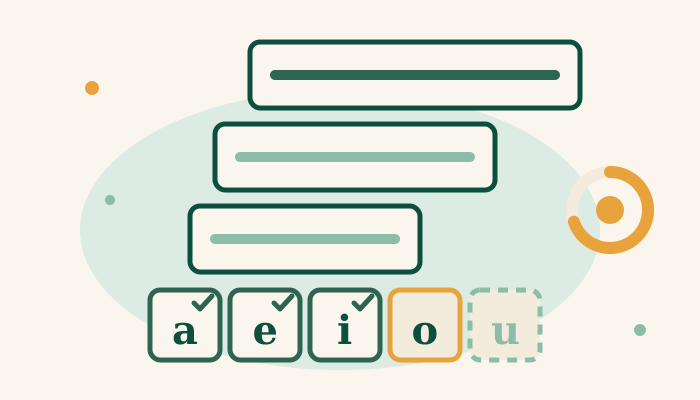
An older child with dyslexia starts at vowel sounds again because the vowel sounds were never made automatic, and every longer word is built on them. At this age the work moves at a teenager’s pace: each sound is checked, taken to about 80 percent, and the next one begins. It is the foundation laid properly, not a step back.
Why do we start with vowel sounds, even at secondary school?
The teenagers who come to me with dyslexia can usually read. That is what makes the vowel question confusing for parents. The child reads short stories, manages most of the words in a message, and gets through the day. What the child cannot do is read a word they have never met, because the way they read is to recognise the first few letters and guess the rest from the shape and the context. A child like this reads “arrive” as “around” and does not notice, because guessing has worked well enough for years.
The sound a guesser skips is the vowel. Consonants are easier: most of them make one sound, and they sit at the edges of a word where a guess can start. Vowels sit in the middle, and each one has several spellings and several sounds. The long sound of “e” alone has six common spellings. A reader who has never been shown that system, or was shown it at six and never practised it to the point of not thinking, has nothing to use when a new word appears. So they guess.
This matters more, not less, as the child gets older, because the words get longer. A child who reads “napkin” by guessing cannot read “contribution” by guessing. The What Works Clearinghouse practice guide on reading interventions for students in grades 4 to 9 (2022) puts this first in its list of recommendations: build students’ decoding skills so they can read complex multisyllabic words (PDF). Louisa Moats, in a 2001 article republished by Reading Rockets, makes the same point from the research on older readers: a core linguistic deficit underlies poor reading at all ages, and older poor readers show the same weaknesses in phonological processing and word recognition that younger ones do. The gap does not become a different kind of gap in the teens. It becomes a bigger one, with more guessing practice on top.
So the first thing I check with an older child is the vowel sounds, and the first thing I teach, if they are not automatic, is the vowel sounds. The order after that follows the structure of the language itself, which the International Dyslexia Association describes as phonology, then sound-symbol mapping, then syllable types, then morphology: short vowels, consonants and their rules, simple words, then the long vowel patterns, then syllable division, then prefixes and suffixes. I explain the whole sequence to parents in what is the Orton-Gillingham approach.
What is different about doing this with a teenager?
The content of vowel work is the same for a teenager as it would be for a seven-year-old. The pace, the explanation and the pay-off are not.
An older child can be told why a rule exists, and will remember it better for the reason. When I teach that for the same /k/ sound “c” comes before a, o and u and “k” comes before i, e and y, a teenager asks why. The answer is that when “c” comes before i, e or y it turns soft and gives the /s/ sound, as in “city”, so “k” has to do the job there. That is something they can hold onto and apply to “cup”, “kit” and “sky” the next week. A younger child mostly needs repetition. An older child needs the repetition and the logic, and the logic is what makes the repetition shorter.
The second difference is the 80%-then-move-on rule. With a young child I can wait for a sound to be close to perfect before I introduce the next, because the child does not mind. A teenager minds. If I hold a teenager on short “a” until every word is right, the sessions turn into something to be endured, and I lose the child long before I lose the sound. So with older children I take each pattern to about 80 percent accuracy and start the next one, and the one I left comes back in the daily drill, in dictation and in reading, until it settles on its own. The sounds are not a chapter we finish and leave. They are more like multiplication tables: you go, you revisit, you go again.
The third difference is that an older child can work out part of the system themselves. When I start a new long vowel sound, I do not begin with the list of spellings. I ask the student to guess how the sound might be written, and a teenager whose earlier patterns are secure usually produces four of the six spellings of long “e” on the whiteboard before I add the last two. That is a very different experience from being taught the alphabet again, and it is the experience I am aiming for.
The practical shape of a session does not change much with age. It still opens with a few minutes of sounds: I write a letter or a letter pair, the student says its sound and a keyword, and then we reverse it, I say a sound and the student writes it. A new concept comes next, then a word-building game, dictation, and reading something real. I have walked through one in what happens in online dyslexia intervention. The difference with a teenager is what fills each slot: an igh-word chain instead of three-letter words, consonant-le dictation instead of “cat” and “mat”, and a story the student actually wants to read.
Starting at vowel sounds is not going back to the beginning of school. It is going back to the one thing school never finished, and finishing it, at a teenager’s pace, in months rather than years.
Is it too basic? What to watch for instead
The worry I hear most from parents of older children is that starting at vowel sounds is “too basic”, and that their child will be bored or insulted. It is a fair worry, and the test for it is simple. Ask the child to read a list of made-up words, “vop”, “slaint”, “thrime”. In my sessions, a child whose vowel sounds are automatic reads them without hesitation, and a child who is guessing stalls, or turns them into real words. The second child is not too advanced for vowel work, whatever their grade.
The same test tells you when the vowel stage is working. I never check a pattern with the words I taught it on, because an older child remembers words by shape and will pass that test without the sound being secure. I check with new words in dictation, and with a story the student has not seen. When a teenager spells “bloat” correctly and then explains that “oa” is the first choice in the middle of a word while “ow” goes at the end, the pattern is theirs. When a student corrects a spelling I have deliberately written wrong on the whiteboard and names the rule I broke, that is the stage I am working towards, and it is not basic at all.
Two things I have noticed in my sessions with older students are worth passing on. First, they often get a word right for the wrong reason, because the word is familiar, and the real test is a word they have not seen. Second, the rule they can recite is not always the rule they can use. A student who can say the doubling rule may still write “hoping” for “hopping”. That is why the drill, the dictation and the reading keep coming back to the same sounds for months, and why an outside observer can mistake that for repetition without progress. What is being built is speed, not knowledge.
What if my child has already done a phonics or Orton-Gillingham programme?
Several of the older children who come to me have already been through a phonics programme, sometimes a good structured one in a pull-out programme at school, and their parents ask, reasonably, what will be different the second time.
My answer is that I do not see the grade of the child, I see the level. In most of these cases the early rules were taught and are partly there. What did not happen is the transfer to the next layer: the long vowel patterns with all their spellings, the suffixing rules such as doubling before “-ing”, syllable division for long words, and the prefixes and suffixes that carry most of the vocabulary in a secondary textbook. The Reading & Spelling Snapshot, an informal reading and spelling assessment done live over about an hour, is how I find where the earlier teaching stopped holding. It costs USD 150, and the follow-up conversation is where I tell you which layer we start from.
For a child in this position the vowel stage is short. We confirm the short vowels in the first sessions, usually find them secure, and spend our time on the long vowel patterns and the rules that come after them. For a child who has never had structured teaching, the vowel stage is longer, and that is the right use of the time. Either way, no child sits through weeks of what they already know. The daily sound drill is a few minutes, and it moves on as soon as the sound does.
How long does the vowel stage take for an older child?
The vowel stage varies in length, and I would rather give you the range I see than a promise. In my sessions, at three to four sessions a week, most older children have the short vowels and the basic consonant rules secure within the first month. The long vowel patterns take longer, because there are more of them and each has several spellings, and I usually see them settle over the following two to three months, with a new pattern started every week or two under the 80%-then-move-on rule. Syllable division and suffixing rules run alongside the later vowel work rather than after it.
The whole programme for an older child typically falls inside the six to eighteen month range I describe in how long does dyslexia intervention take, with the early months often moving faster than parents expect, because an older child understands the rules quickly, and the later months slower, because old guessing habits are well practised. What is secure, what is in progress and what comes next is exactly what we go through on the monthly parent progress call.
What does it ask of the teenager and of you?
Three or four sessions a week of 45 to 60 minutes, online, with the student at a desk and a notebook or whiteboard in reach. Between sessions, ten minutes of dictation at home on the words and patterns I send, and the completed work photographed back to me. That is the whole ask, and it is enough.
Two things make the home part work. The first is to use the same words I use. If your child stalls on a word and you say “blend, don’t guess”, in those words, every time, the instruction carries from my screen to your kitchen table. If you say “sound it out” one day and “just read it” the next, it does not. The second is to test with my patterns, not with a word list from school. Parents of older children often want to run their own spelling tests, and I understand why. Send me the list first. A list built on patterns the student has not yet been taught produces failure that tells neither of us anything.
Boredom is a real risk with a teenager and I plan for it rather than hope it away. The 80%-then-move-on rule is the main defence. The others are the shape of the session (no part longer than fifteen minutes, a short break in the middle), letting the student run the word-building game, and reading material chosen for the student rather than for the sound. When attention is also a factor, which it often is, the adjustments are similar and I have written about them in dyslexia or ADHD. What I cannot fix from my side is a student who will not sit with the class at all. If that is where your child is, we talk about that first, before any vowel sound.
Who is this not for?
Starting at vowel sounds is the right first step for an older child who reads by guessing, whether or not there is a diagnosis. It is not the right first step for every teenager who is struggling with English.
A teenager who reads accurately and fluently but does not understand what they read has a different problem, and vowel work will not help it. I have written about that child in my child reads fluently but doesn’t understand. A teenager in an exam year who needs subject revision, timed papers and marking needs an exam tutor for that, and I say so when it comes up, because an hour spent on the wrong thing before a board exam is expensive. And a child who is not ready to attend, because of anxiety, a bad school year or something else going on at home, needs that looked at first; no teaching lands on a child who cannot yet sit through it.
If the signs in signs of dyslexia by age for teenagers describe your child, and especially if reading a new word is still a guess, then starting at the vowel sounds is the step that was missed, and the right place to begin.
Dr. V.S. Gayathri works one-to-one with children and teenagers in several countries, and most of the older students at Flourishing Kids start exactly here. If you would like to talk through where your child would start, get in touch.
Frequently asked questions
Is it embarrassing for a teenager to go back to letter sounds?
It can feel that way in the first week, and I say so to the student directly. I tell them we are checking, not starting over, and that anything they already know gets a few minutes and is gone. The embarrassment usually ends the first time they read a word they would have guessed a few weeks earlier. Sessions are one-to-one and online, so no classmate sees any of it.
My child already knows the vowel sounds. Why test them again?
Knowing a sound and using it without thinking are different things. Most of the older children I see can name the short vowel sounds if asked. Far fewer use them when they meet a new word under time pressure, which is what reading at secondary school demands. The Snapshot checks the second thing, with words the child has not seen, and we start from wherever that holds.
Will starting at vowels delay exam preparation?
For a child who guesses at words, there is no exam preparation that works without this. Revision notes, question papers and textbooks are all made of words, and a student who cannot read new words accurately cannot use them. The vowel stage for an older child is months, not years, and I keep the sessions moving with the 80%-then-move-on rule. Subject revision itself is a job for an exam tutor, and the two can run in the same month.
Does my teenager need a dyslexia diagnosis before starting?
No. Whether a child comes to me with a diagnosis or without one, the teaching is the same, because it is built on where the child is, not on the label. A formal assessment matters when the school or examination board needs it for accommodations such as extra time or a scribe, and I have written about that route in how to get a child assessed for dyslexia.
How many sessions a week does an older child need?
Three to four sessions a week of 45 to 60 minutes. In my experience, with fewer than that the sounds do not get the chance to become automatic between sessions, which is the whole point of the vowel stage. The frequency is the same for younger children; what changes with age is how quickly each pattern moves from taught to secure.
Dr. V.S. Gayathri is a Dyslexia Therapist, an Orton-Gillingham trained literacy specialist, and the founder of Flourishing Kids. She has delivered over 4,000 hours of one-to-one reading and spelling intervention, helping children across multiple countries build stronger literacy skills. If you have an older child who still guesses at new words, get in touch for a free 15-minute conversation about where a programme would start.