From reading intervention to exam study skills: mnemonics and mind maps for teens
By Dr. V.S. Gayathri ·
dyslexia learning
Dyslexia intervention for a teenager adds exam study skills once the reading and spelling basics are secure, usually a few months in. The tools are first-letter mnemonics and mind maps, taught on the child’s own textbook chapter rather than a worksheet, so the way the child learned to read becomes the way the child learns to study.
When does study-skills work start in dyslexia intervention?
Study skills start when the reading and spelling foundations no longer take most of the child’s attention. In my sessions with older students that point usually comes a few months into the programme, when the short vowels and the basic consonant rules are automatic and the long vowel patterns are under way. The test I use is simple: the task should not use much of the child’s memory. If decoding a word still takes effort, a mind map of a chapter is two hard jobs at once, and the child does neither well.
Until then the session keeps its usual shape, which I describe in what happens in online dyslexia intervention. Older students still open with sounds and with the key-sentence tool, a memorised sentence for each vowel sound that holds all of that sound’s spellings. The study-skills work is added in slices, ten or fifteen minutes at the end of a session, and only on the days the child has the energy for it. I do not teach it as a separate course. The 80%-then-move-on rule applies here too: once a pattern is about 80 percent secure, the time it frees up goes to the next thing the child needs, and for a secondary-school student the next thing is often how to hold a chapter in memory for a test.
Two rules keep the two jobs from colliding. First, in study-skills work I ignore spelling errors, except for a pattern we have already learned, where I point back to the rule and the child corrects it. Second, I never use a generic worksheet. The material is the child’s own textbook, sent to me as photographs or a PDF, so every technique is practised on something the child will be examined on.
What does a mnemonic lesson look like?
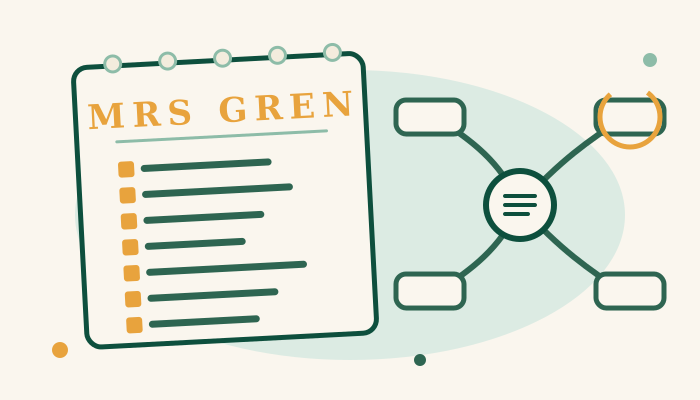
A mnemonic lesson starts with one the student already half knows. Mrs Gren carries the seven characteristics of living things: movement, respiration, sensitivity, growth, reproduction, excretion, nutrition. The students I work with usually meet this list in early secondary biology, and seeing a familiar list unpacked this way, one letter for each item, is the moment the idea lands.
This is the first-letter strategy. I describe the mnemonic to students as a file name: once the child can find the file, writing out what is inside it is the easy part. The same move works on any list the child has to carry into an exam, and where the letters refuse to make a word, each one starts a word in a short sentence instead. The first-letter strategy is one of the three forms of mnemonic that research with students who have learning disabilities has found effective (Fairbrother and Whitley, 2014, summarising Mastropieri and Scruggs), because it draws on memory for pictures and sounds, which that research describes as a relative strength for these students.
Mnemonics have a limit, and I tell students about it. A 2013 review of ten study techniques by Dunlosky and colleagues rated the keyword mnemonic as low utility and practice testing as high utility, because that kind of mnemonic helps with a limited range of material and tends to fade unless it is revisited. I treat first-letter mnemonics with the same caution. A mnemonic is never left on the whiteboard; the child says it back from memory at the start of the next session, and again before the test.
How does a textbook chapter become a mind map?
A mind map turns a chapter into something a child with dyslexia can hold in one look. The chapter title sits in the middle. Each heading becomes a branch. Under each branch go phrases, not sentences, because the map is for recall and a full sentence is more reading than remembering. I teach the map on the child’s own chapter, then set a second chapter for the child to map alone, so I can see whether the method has transferred. If the map starts turning into an art project, I cut the drawing and ask the child to explain each branch to me from memory first.
A mnemonic is only the file name. A child who can find the file under exam pressure, and say what is inside it, has most of what a test is really asking for.
When I taught in a school, I once asked that a whole class’s homework for a chapter be a mind map instead of the back-of-the-book questions. It was easier to see who had understood the chapter from thirty maps than from thirty sets of copied answers. I make the same request of a child’s tutor or subject teacher now: whatever homework they set, please set it in the same shape I am teaching, so the child is practising one method, not two.
What does a scribe solve, and what does it not?
A scribe solves the writing problem in an exam and nothing else. For a child with dyslexia whose handwriting is slow or whose spelling collapses under time pressure, being allowed to dictate answers removes a real barrier, and I support families in asking for it. A scribe is one of several exam access arrangements, alongside a reader and extra time, and in the British system the school gathers the evidence and applies, as the British Dyslexia Association explains. For Cambridge international examinations the request also goes through the school or centre, never through the parent directly, with the evidence of need attached. In India the route runs through a disability certificate and each board’s own rules, which vary; the formal assessment that starts it is done by a psychologist, and when your child may need more than literacy intervention explains which professionals do that work.
What a scribe does not solve is retrieval. The child still has to understand the concept, hold it, and bring it back on the day in words a scribe can write down. The mnemonics and the mind map are what make that possible; the scribe only takes away the pen.
When does a subject tutor join, and what stays with me?
A subject tutor joins when the child needs exam content, and I am not the subject teacher. There is a stage, usually in the exam years, when a child who can now read the chapter still needs someone to tell them which parts matter, what the one-mark questions look like, and how to work through a past paper in the time allowed. An exam-oriented tutor, ideally someone who has worked inside the child’s own board, does that job and should be brought in alongside the intervention, not after it. I explain the difference between the two jobs in remedial teaching versus tuition.
What stays with me is the method. When a family brings in a tutor I ask for a short call with them, and I explain the techniques the child is using and ask that homework and revision follow the same path. A child with dyslexia should not be learning two systems at once. I also help the family set a realistic target. For a child in an exam year who started intervention late, the honest aim is often a secure pass rather than a top grade, and saying that aloud takes a great deal of pressure off the child.
Families on a first call often ask what happens when the intervention ends. My usual answer is that the child moves to an English teacher or an all-subjects tutor who can keep the study habits going, and that I remain available for a check-in if something slips. The monthly parent progress call is where we decide when that hand-over is close; I describe it in what a monthly parent progress call covers.
Who is this for, and who is it not for?
Study skills inside dyslexia intervention suit a secondary-school student whose reading and spelling basics are secure, or nearly so, and who has exams within the next year or two. The child needs to be old enough to find the humour in a silly sentence and to see a chapter as a set of headings; in my sessions that is usually from about twelve.
It is not for a child still at the vowel stage. Adding mind maps to a child who cannot yet decode the chapter gives the child two things to fail at, and I would rather finish the foundations first; why an older child starts at vowel sounds again explains that order. It is also not a substitute for subject teaching. Mnemonics help a child remember what they understood; they do not create the understanding. And it is not a last-minute fix. A child who comes to me two months before a board exam with no reading foundation needs an exam tutor and a scribe application, not a study-skills programme, and I will say so on the first call rather than take the child on.
What do study skills ask of the parent?
Study skills ask the parent for two things. Send me the chapter the child is being tested on, as photographs or a PDF, a few days before the test rather than the night before. And ask the child to say the mnemonic, or to explain one branch of the map, rather than asking whether they have studied. The first question gets a demonstration; the second gets a yes.
Frequently asked questions
Can study skills be taught before the reading is fixed?
Not well, in my experience. Mnemonics and mind maps both depend on the child reading the chapter accurately enough to know what is in it. A child who is still guessing at long words will map the wrong content. The foundations come first, and the study skills are added once decoding no longer takes most of the child’s attention, which how long does dyslexia intervention take puts a timeline on.
Do mnemonics work for everything?
No. They work for lists, orders and names. They do not work for understanding a process or writing an explanation, and the 2013 Dunlosky review found the keyword type fades unless it is revisited, so each one is said back from memory in later sessions rather than written once and forgotten.
Do you teach the school subjects?
No. I teach the child how to study a subject, using their own textbook, and I ask the family to bring in an exam-oriented tutor when the child needs the content itself. My classes are dyslexia intervention, not tuition, and the two work best side by side with the tutor using the same techniques.
Does my child need a scribe for board exams?
Some do. If the handwriting is slow or the spelling breaks down under time pressure, a scribe removes a barrier the intervention cannot remove in time. For British and Cambridge exams the school applies, not the parent; Indian boards have their own routes. Either way the child still needs to bring the answer back on the day, which is the part I prepare them for.
How do we start?
Every family at Flourishing Kids begins with the Reading & Spelling Snapshot, an informal reading and spelling assessment done online. Assessment fee: USD 150. The Snapshot shows whether the foundations are secure enough for study-skills work to start now or whether the vowel stage comes first, and the follow-up conversation covers the plan.
Dr. V.S. Gayathri is a Dyslexia Therapist, an Orton-Gillingham trained literacy specialist, and the founder of Flourishing Kids. She has delivered over 4,000 hours of one-to-one reading and spelling intervention, helping children across multiple countries build stronger literacy skills. If your teenager reads well enough but cannot hold a chapter for a test, get in touch for a free 15-minute conversation about where study skills would fit.