What is a remedial class? A parent's guide
By Dr. V.S. Gayathri ·
reading learning
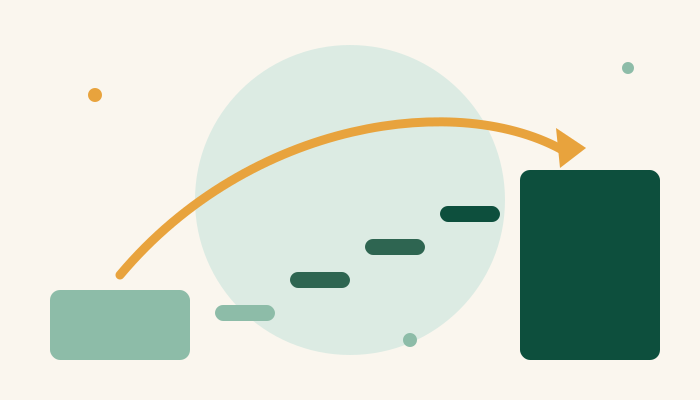
A remedial class is a structured, one-to-one lesson that rebuilds the foundational skills a child has missed, usually in reading, spelling or maths, instead of re-teaching the school syllabus. The teaching is explicit, systematic and multisensory, starts from the child’s actual level regardless of grade, and continues until each skill is mastered and automatic.
What does “remedial” actually mean?
The word simply means “intended to repair”. A remedial class bridges the gap between what a child currently knows and what their age and grade expect. It does that by setting the syllabus aside and rebuilding the foundations underneath it. I have written a fuller piece on what remedial classes are and why some children need them; this page is the short map of the whole territory.
Good remedial teaching has a recognisable shape wherever you find it: systematic, highly structured, explicit, multisensory, and taught to mastery rather than to a timetable. Each skill becomes automatic before the next one is stacked on top. For reading, the skills are rebuilt in a known sequence: phonological awareness, then phonemic awareness, then phonics, then vocabulary, syntax, comprehension and fluency.
How is a remedial class different from tuition?
Tuition re-teaches this term’s content: the same syllabus, a second pass, a slower pace. A remedial class ignores this term’s content and rebuilds the skills the content is printed in. If your child understands everything when you explain it aloud but still cannot read, write or spell it, tuition alone will not close the gap. I have compared the two honestly, with the questions that settle which one your child needs, in remedial teaching vs tuition.
How is remedial education different from special education?
Remedial education serves children of average or above-average intelligence who have a specific skill gap to close. Special education is a wider umbrella for children whose needs a mainstream classroom or a remedial setting cannot meet. The two overlap far less than parents fear, and the difference between special education and remedial education is worth understanding before either label worries you.
What happens inside a remedial class?
A typical session runs 45 to 60 minutes: warm-up sound drills, one new concept taught through sight, sound and movement together, then reading, spelling and dictation that use it. Sessions run three to four times a week, and frequency matters more than length. I have walked through a full session, minute by minute, in what a remedial teacher does in a session. For reading and spelling, the best-known method behind this structure is the Orton-Gillingham approach.
Nearly every child who starts with me arrives expecting one more class where reading will be hard. In my 4,000+ hours of one-to-one intervention, the same turn happens again and again: within the first couple of weeks, a child who has spent years finding print difficult reads a short page built only from patterns she has actually been taught, stops, and looks up to check whether it really happened. That look, not the worksheet, is what a remedial class exists to produce.
A remedial class does not re-teach the syllabus. It rebuilds the skills the syllabus is printed in, one mastered step at a time, until success stops being a surprise.
How do I know if my child needs a remedial class?
The clearest signs: your child understands when listening but struggles with the same material in print, spells the same word three different ways, guesses at words from the first letter, or still confuses letters well past age seven, despite genuine effort. I keep a fuller checklist in does my child need remedial classes? And if you would rather settle the question than keep wondering, an informal assessment shows in an hour or two where the gaps actually sit.
Can remedial classes be done online?
Yes, fully, as long as the class stays one-to-one, structured and multisensory, and the child is about six or older. At Flourishing Kids I teach children in India, the UAE, Oman, Singapore, Australia, the UK and the US this way. The practical details, what changes on a screen and what does not, are in can remedial classes be done online?
How long do remedial classes take to work?
Because the work is mastery-based, the pace is set by the depth of the gap, not the calendar. The first visible changes, such as more willing reading and steadier spelling of taught patterns, usually appear within the first few weeks. The full rebuild takes several months to about two years, depending on how far down the gaps begin.
Frequently asked questions
Do remedial classes replace school or tuition?
No. Remedial classes run alongside school. Tuition can hold the line on this term’s content while the remedial work rebuilds the foundations underneath it: foundations first, or at least foundations alongside. The tuition comparison walks through how the two fit together.
At what age can a child start?
Foundational skills can be checked and strengthened from age five or six. Online sessions work from about six, with a parent nearby in the early weeks. Do not wait for a formal diagnosis; in India that is usually only possible around age eight, and the years before it are exactly when the rebuilding is easiest.
What should I look for in a remedial teacher?
Ask about training and method, not just years of experience. You want specific training in a structured, research-based method (for reading and spelling, Orton-Gillingham is the best-known), a diagnostic assessment before teaching begins, one-to-one instruction, and pacing based on mastery rather than a fixed syllabus.
Dr. V.S. Gayathri is a Certified Dyslexia Therapist, an Orton-Gillingham trained literacy specialist, and the founder of Flourishing Kids. She has delivered over 4,000 hours of one-to-one reading and spelling intervention, helping children across multiple countries build stronger literacy skills. If you are wondering whether a remedial class is what your child needs, get in touch for a free 15-minute conversation.