Special education vs remedial education: what is the difference?
By Dr. V.S. Gayathri ·
learning school
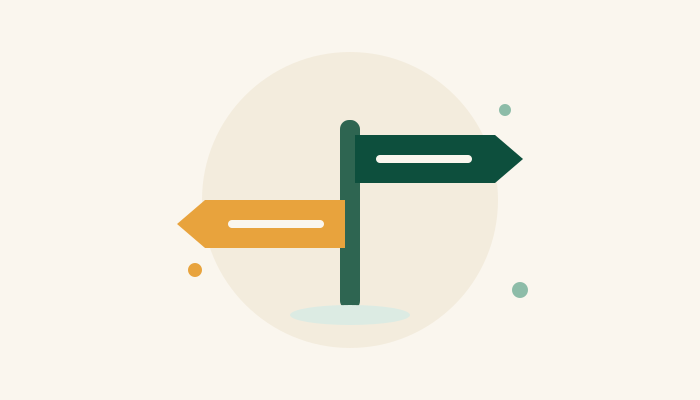
Remedial education is for students of average or above-average intelligence who struggle in a traditional school environment; it closes specific skill gaps through individualised teaching. Special education is a wider umbrella for students whose intellectual, social, emotional or physical needs cannot be met in a mainstream or remedial setting. Most children with a learning difficulty need the first, not the second.
Parents dealing with a learning difficulty are often unsure which kind of help to seek, and the two terms get used interchangeably, which does not help. Both are specialised, structured programmes for students who need extra academic attention. The difference lies in who they serve and what they aim to do.
What does a learning difficulty look like first?
The impact of a Specific Learning Disorder (SLD) differs from child to child, and depends on two things above all: the severity of the condition, and how timely and effective the remedial education is. The core difficulties show up in word recognition, reading fluency, reading comprehension, spelling, and written expression.
One pattern is worth knowing: some students with SLD manage early reading and spelling, especially with excellent instruction, and hit their hardest wall later, when more complex language skills arrive: grammar, understanding textbook material, writing essays. A child who “was fine until Class 5” may not have suddenly developed a problem; the problem may have been waiting for the curriculum to catch up with it.
What is remedial education?
Remedial education is designed for students with average or higher-than-average intelligence who nonetheless cannot perform well with the traditional curriculum in a traditional classroom. It uses individualised instruction, built on the student’s specific requirements rather than full-class teaching, and its goal is to return the child to the mainstream curriculum at full strength. I have written in more detail about what remedial classes involve and who needs them.
What is special education?
Special education is a much wider umbrella. It serves students whose needs go beyond what a mainstream or remedial environment can meet: children who need support with intellectual functioning, social maturity, emotional maturity, or physical ability, and for whom a standardised classroom, even with remedial help, is not the right setting. It is a different kind of provision for a different kind of need, not a “more serious” version of remedial teaching.
A practical signal: a child who makes no progress in a well-run remedial programme may need the fuller assessment and provision of special education. But that is discovered by trying good remedial teaching first, not by assuming the worst at the outset.
Why should remedial education be the first choice?
For a child showing early signs of learning difficulty, remedial education is usually the right starting point, and it is effective when it is:
- Research-based, using proven teaching methods
- Structured and explicit in how it is taught
- Conducted at the student’s pace
- Full of regular review and practice, so new knowledge gets applied and reinforced
- Multisensory, engaging more than one learning pathway at a time
- Scaffolded, with support gradually removed as the child gains independence
Try good remedial teaching first. The child’s response to it is the best assessment there is.
Every child with SLD has different needs, abilities, strengths and learning styles. The right remedial intervention helps them overcome the learning challenges, build the complex academic skills their peers are building, catch up, and, just as valuably, rebuild their confidence and their attitude towards learning itself.
Frequently asked questions
My child has been recommended for special education. Should I try remedial classes first?
That depends on the basis of the recommendation. If it rests on a thorough assessment of intellectual and developmental needs, take it seriously. If it rests mainly on poor marks and classroom struggle, ask whether structured remedial teaching has been tried, because a child of normal intelligence with an untreated learning difficulty can look, on paper, like a candidate for special education.
Can a child move between the two?
Yes. Children who make strong progress in special education settings can transition towards mainstream with remedial support, and children who stall in remedial programmes can be reassessed for fuller provision. Neither placement is permanent; the child’s response to teaching is the guide.
Dr. V.S. Gayathri is a Dyslexia Therapist, an Orton-Gillingham trained literacy specialist, and the founder of Flourishing Kids. She has delivered over 4,000 hours of one-to-one reading and spelling intervention, helping children across multiple countries build stronger literacy skills. If you are weighing up the right kind of help for your child, get in touch for a free 15-minute conversation.