Two modes of thinking: focused and diffuse, and why learners need both
By Dr. V.S. Gayathri ·
learning
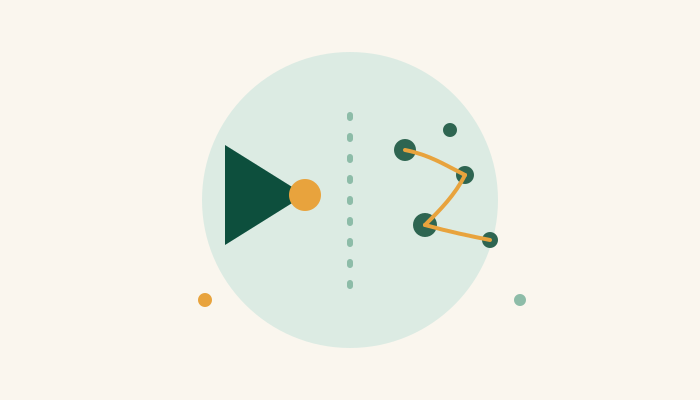
The brain learns in two complementary modes. Focused thinking concentrates hard on the problem at hand and builds the initial skill; diffuse thinking wanders, sees the bigger picture, and connects new knowledge across the whole brain. Neither is better; mastering anything requires alternating between the two, which is why breaks are part of studying, not a break from it.
From birth we learn through all our senses, but the test of knowledge comes when we apply it: handling, managing and executing real situations. That is where learning turns into thinking, and it is worth knowing how the machinery works.
Psychologists describe the mind with a useful dual-system analogy. System 1 thinking is automatic, quick, intuitive, emotional and reactive; it jumps to answers. System 2 is conscious, effortful, logical and deliberate; it reasons its way to answers. The brain is not literally split in two, but the analogy earns its keep, and for learners it maps onto a practical pair: the focused and diffuse modes of thinking.
The focused mode
Focused thinking is straightforward concentration on the matter at hand: a highly attentive state where the brain applies its best concentration and shuts out external information. It runs like a one-track mind, no room for distraction, zooming directly in on the most explicit information, whether the problem is physical or analytical. It is the preferred mode for studying knowledge-intensive subjects, and it is what most people picture when they picture “studying”.
The diffuse mode
Diffuse thinking looks at the big picture, and unlike focused thinking, it welcomes wandering. The mind drifts, pokes into details, and makes connections at random, using the whole brain rather than one concentrated region. That breadth is its beauty: diffuse thinking is where the dots get connected.
It happens while you do other, more leisurely things. This is why a shower or a run after studying can produce the breakthrough that an extra hour at the desk would not: while the conscious mind relaxes, the brain quietly forms the creative solution, linking ideas that focused thought kept passing over. (The linking is physical, too; this is what happens in the brain when we learn.)
The insight your child cannot force at the desk often arrives on the walk afterwards. The walk is part of the studying.
Which mode is better?
Neither; the question judges a partnership as a contest. The two modes are opposites, and both are required to master a topic or make progress on anything difficult. Learning something new needs the specifics of the subject (focused) and the context around the information (diffuse). The brain runs both modes for good reason, and learners see better results when they deliberately use both.
What does this mean for your child’s study habits?
Three practical translations:
- Work in genuine focus blocks. Short, distraction-free stretches of real concentration, phone elsewhere, one task. Twenty minutes of true focused mode beats an hour of half-attention.
- Honour the breaks. After a focus block, let the mind actually wander: play, a walk, staring out of the window. That is the diffuse mode on duty. A break spent on another screen task steals the wandering time the brain needed.
- Sleep on the hard thing. Stuck on a concept in the evening? Stop, sleep, return in the morning. Diffuse processing overnight routinely does what late-night grinding cannot.
For children with learning difficulties, this rhythm matters even more, because their focused mode costs more effort per minute. Structured teaching respects that by keeping lessons in small, digestible steps with genuine pauses between them, letting both modes do their share of the work.
Dr. V.S. Gayathri is a Dyslexia Therapist, an Orton-Gillingham trained literacy specialist, and the founder of Flourishing Kids. She has delivered over 4,000 hours of one-to-one reading and spelling intervention, helping children across multiple countries build stronger literacy skills. To talk about study rhythms that suit your child’s brain, get in touch for a free 15-minute conversation.