The importance of child-led free play
By Dr. V.S. Gayathri ·
activities parenting
Child-led free play is unstructured playtime the child directs: they choose the game, make the rules and set the pace, with adults following rather than instructing. Research links it to stronger self-regulation, creativity, decision making and school readiness, and encouraging it takes little more than a safe space, good materials and a tolerance for mess.
Playtime through the growing years develops both body and mind, and it comes in kinds: a child playing alone, playing with you, or learning through experiential play. Somewhere along the way many of us absorbed the idea that even play should be constructive and organised. Experts think otherwise, and meanwhile screens keep eating the hours that used to belong to play.
Peter Gray, professor of psychology at Boston College, has written in the American Journal of Play about what the decline of play costs children: the lack of it affects emotional development and feeds the rise of anxiety, depression, and problems of attention and self-control.
What is free play?
Free play is playtime led by the child, which is why it is called child-led free play. Adults may be involved, but the child drives it entirely; nothing is directed, and it may be unstructured and gloriously disorganised. It is easiest to achieve with two or more children.
The child focuses on their own interests, makes their own rules and communicates their own way. Choice is the whole point. They use their imagination, build their own structures, and often try on adult roles they have observed. It is how children begin to understand the world around them.
The research backs the instinct. Self-regulation skills are foundational to life outcomes, and one longitudinal study found that the more time children spent in unstructured quiet play as toddlers and preschoolers, the better their self-regulation at ages 4 to 5 and 6 to 7.
What does free play look like?
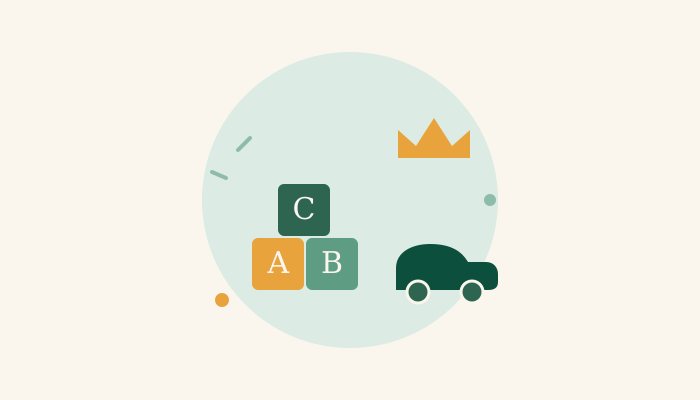
Any unstructured activity that runs on imagination: blocks, dolls, toy cars, whatever they like, and mostly not electronic toys. A group of kids playing football in the backyard is free play; the same kids on a team with a coach is not, and both have their place. More examples:
- Drawing, colouring, painting, cutting and gluing with art supplies
- Make-believe and dress-up
- Playground equipment: climbing, swinging, running around
- Reading books they enjoy, for pleasure rather than homework
What are the benefits of free play?
The American Academy of Pediatrics, in a special report on play, lists what free play does:
- Lets children use creativity and develop imagination and their other strengths
- Encourages them to interact with and explore the world, learning naturally in the process
- Helps them adjust to school early, improving learning readiness, learning behaviour and problem solving
- Builds the self-regulation the toddler study measured
- Develops decision-making skills
- Teaches group play, sharing and conflict resolution, growing interpersonal skills early
How can parents encourage free play?
Provide a safe space. Free play means exploring and doing things on their own; independence needs an environment where that is safe.
Listen to your child. Ask “what do you want to do today?” and build around the answer. If they want to build a house, supply materials and room. No puzzle in the house? Cut up an old calendar picture. Reuse, improvise, be as creative as they are.
Give clues, not answers. When a problem stops them, ask “what do you want to happen? How can we solve this?” Support them towards thinking it through themselves.
Make it bonding when you can. Join the play sometimes. And when they want to play while you are working, agree on something they can do alone, then look it over together afterwards.
Don’t worry about mess. Do not stop a young child mid-play because of it, and do not scold. Talk later about tidying up; the mess is often the visible half of the learning.
Organised activities teach a child what adults know. Free play teaches a child what they themselves can figure out, and that lesson has no substitute.
Dr. V.S. Gayathri is a Dyslexia Therapist, an Orton-Gillingham trained literacy specialist, and the founder of Flourishing Kids. She has delivered over 4,000 hours of one-to-one reading and spelling intervention, helping children across multiple countries build stronger literacy skills. Play is also how struggling learners rebuild confidence; get in touch for a free 15-minute conversation.