Neuroplasticity and learning: how the brain rewires itself
By Dr. V.S. Gayathri ·
learning
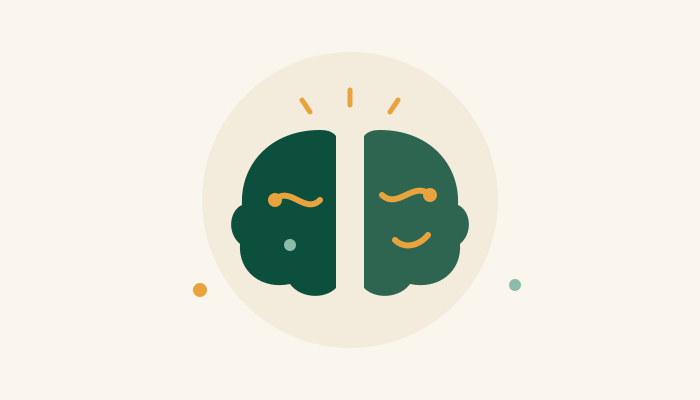
Neuroplasticity is the brain’s ability to reorganise itself by forming new neural connections throughout life. It is how learning physically happens, how the brain compensates for injury, and why children, whose plasticity is strongest, respond so well to good teaching. You can strengthen it through enriched learning environments and plenty of sleep.
“You fill a bucket drop by drop. You clear your mind thought by thought,” writes Lisa Wimberger. We clear old thoughts to make way for new ideas without realising the machinery underneath: neuroplasticity, deeply connected to everything we learn.
What is neuroplasticity?
The ability of the brain to reorganise itself by forming new connections between neurons, the cells that make up the brain, throughout life. It lets neurons compensate for injury and disease, and adjust to new situations and environments. The term was first used by Polish neuroscientist Jerzy Konorski in 1948 to describe observed changes in neuronal structure, though it only entered wide use in the 1960s.
Neuroplasticity occurs through learning, experience and memory formation, or in response to brain damage. Researchers Christopher Shaw and Jill McEachern describe two framings: neuroplasticity as one fundamental process behind any change in neural activity or behaviour, or as an umbrella term for a vast collection of brain-change phenomena. The dramatic demonstrations come from injury: when one hemisphere is damaged, the intact hemisphere can take over some of its functions, the brain reorganising and forming new connections between healthy neurons, provided those neurons are stimulated through activity.
Two main types are usually distinguished: structural neuroplasticity, where the strength of connections between neurons changes, and functional neuroplasticity, the lasting changes in synapses produced by learning and development.
Neuroplasticity in children
A child’s brain is constantly growing, developing and changing; every new experience alters brain structure, function, or both. At birth an infant’s neurons are already richly connected, and by age two, a child’s brain holds more than double the connections of an average adult brain. Those connections are then pruned and shaped as the child grows into their own unique patterns.
Researchers describe four types of plasticity in children: adaptive (changes from practising a skill, or the brain adapting around injury), impaired (changes due to genetic disorders), excessive (reorganisation into unhelpful pathways that can produce disability), and plasticity that leaves the brain vulnerable to injury. The overall force is stronger in young children than adults, which is why children recover from brain injury so remarkably, and why early intervention in learning difficulties pays back so heavily: the wiring is most willing to change exactly when the child is young. This is the science underneath everything I have written about what happens in the brain when we learn, and it is the reason structured dyslexia intervention works at all: the reading brain can be rebuilt, connection by connection.
Neuroplasticity is the biological small print under every hopeful sentence in education: the brain that struggles today is not the brain your child is stuck with.
What are the benefits?
An adaptable brain promotes the ability to learn new things, enhances existing cognitive capabilities, supports recovery from strokes and traumatic brain injuries, strengthens other areas when some functions are lost, and generally keeps the brain fit.
How can you improve neuroplasticity?
Enrich the environment. Learning environments full of focused attention, novelty and challenge stimulate positive brain change, most powerfully in childhood and adolescence, but rewardingly at every age. Try learning a new language or a musical instrument, travelling and exploring new places, creative work like art, and, of course, reading.
Get plenty of sleep. Research shows sleep plays a central role in brain growth: dendrites, the branches at the ends of neurons that pass information onward, strengthen with good sleep, and stronger connections mean better plasticity. Good sleep hygiene, for you and your children, is brain training that costs nothing.
Frequently asked questions
Does neuroplasticity decline with age?
It moderates, but it never stops. Children rewire fastest, which is the case for early intervention; adults still form new connections whenever they learn, practise and rest well.
What does neuroplasticity mean for a child with a learning difficulty?
Everything hopeful. The difficulty is real, but the wiring is changeable: with explicit, repeated, multisensory teaching, new reading pathways physically form. The diagnosis describes the starting point, not the destination.
Dr. V.S. Gayathri is a Dyslexia Therapist, an Orton-Gillingham trained literacy specialist, and the founder of Flourishing Kids. She has delivered over 4,000 hours of one-to-one reading and spelling intervention, helping children across multiple countries build stronger literacy skills. in the firm knowledge that brains rewire. To talk about your child’s rewiring potential, get in touch for a free 15-minute conversation.