How parents can teach their children about personal space
By Dr. V.S. Gayathri ·
parenting
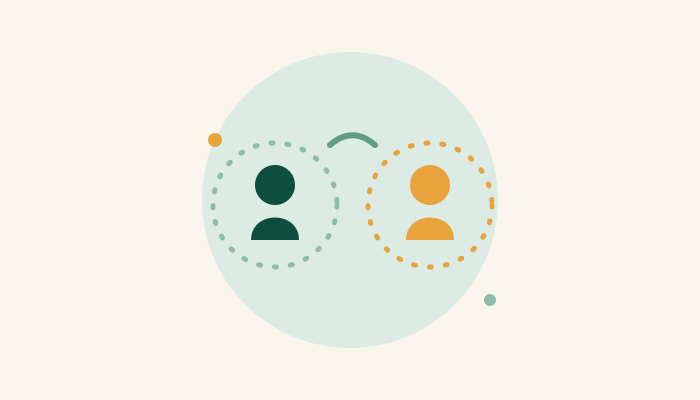
Personal space is the distance we keep between ourselves and others, and for children it is above all a safety lesson: understanding their own boundaries, their right to say no to touch, and their duty to respect others’ space. Teach it by modelling consent at home, letting children choose their own hugs, and keeping communication wide open.
Personal space varies from person to person, but basic rules and guidelines hold, and they shape social interactions, relationships and personal safety. Adults mostly manage it; for children the concept is harder, and because they are vulnerable, learning it early is not etiquette but protection.
What is personal space?
Simply, the distance you maintain between yourself and others, and it is subjective: what feels too close for you may be fine for someone else. Boundaries are shaped by cultural differences, childhood experiences and upbringing, personality traits like introversion, age and gender, neurological differences such as autism, and stress.
The anthropologist Edward Hall, in The Hidden Dimension, mapped four zones:
- Intimate distance: direct body contact, reserved for partners, family and close friends.
- Personal distance: roughly 1 to 4 feet, depending on the relationship; the professional, respectful default.
- Social distance: about 4 to 12 feet, for formal situations like serving customers or small presentations.
- Public distance: 12 to 25 feet or more, for addressing audiences.
Children who learn these zones learn something bigger underneath: their right to privacy, the fact that some parts of their body are not for others to touch, and the appropriate ways to touch someone else. This is body-safety education wearing its everyday clothes.
Five ways to teach it at home
1. Model it first
Exhibit the guidelines before teaching them: past a certain age, ask your child’s permission before hugging and kissing them. The question itself is the lesson: bodies belong to their owners, even small ones.
2. Let them choose their affection
Allow children to decide whom they kiss and hug, and never use emotional blackmail or embarrassment to force it (“give uncle a hug” teaches exactly the wrong reflex). A child who feels safe declining an adult’s touch is a child a predator cannot easily silence; guilt about saying no to grown-ups is precisely the vulnerability to remove.
3. Use stories and play
For younger children, stories, videos, games and activities explain personal space better than lectures; fun is how small children retain.
4. Teach respect for others’ space
The lesson runs both ways: social manners with friends, family and strangers include not crowding, grabbing or touching without invitation. Respecting boundaries is a core social skill and part of keeping everyone safe.
5. Keep the communication channel open
Above all, your child must feel free to come to you with any doubt or any situation that felt wrong. An open channel protects their safety and quietly builds self-worth and healthy body image alongside; listening well is what keeps that channel open.
“You don’t have to hug anyone you don’t want to” is one sentence long, and it may be the most protective sentence a parent ever says.
Some children, particularly those with sensory differences or autism, experience personal space differently in both directions, needing more themselves while reading others’ boundaries less easily. For them, explicit, patient teaching of the zones, with role play and practice, replaces the intuition other children absorb unaided.
Dr. V.S. Gayathri is a Dyslexia Therapist, an Orton-Gillingham trained literacy specialist, and the founder of Flourishing Kids. She has delivered over 4,000 hours of one-to-one reading and spelling intervention, helping children across multiple countries build stronger literacy skills. To talk about boundaries, safety and social skills for your child, get in touch for a free 15-minute conversation.