Engaging SEL activities for every age
By Dr. V.S. Gayathri ·
activities learning
Social-emotional learning (SEL) activities scale with age: mood charts and sensory play for toddlers, feelings comics and family yoga for elementary years, goal setting and expression work for middle school, journaling and presentations for teens. Indian research links SEL directly to results: students’ academic performance ran 16 percent higher in correlation with their social-emotional scores.
SEL is the process by which children (and adults) develop the knowledge, self-awareness and personal wellbeing to build emotional competencies for academics and life. It has moved to the centre of Indian education: the National Education Policy 2020 made SEL a key part of the system, schools are integrating it into core curricula, and the pandemic underlined why, as students faced heavy stress through remote learning.
The evidence says the work is needed. The CASS study by the Centre for Science of Student Learning found SEL skill levels low across both government and private schools, and found the correlation that should make every parent look twice: student performance enhanced by 16 percent in direct relation to social-emotional learning scores. (SEL-guided classrooms show what school-side implementation looks like.)
Here are age-wise activities for home and classroom.
Toddlers and preschoolers
Play. The best form of learning at this age, with heavy parental involvement: display different emotions during play, build motor and sensory skills with kits and board books, and use reading and storytelling as the gateway to the world of feelings.
Art. A blank canvas and kid-friendly colours, with the rule being no rules first: let them try before you tell them the sky is blue. Imagination leads; labels follow.
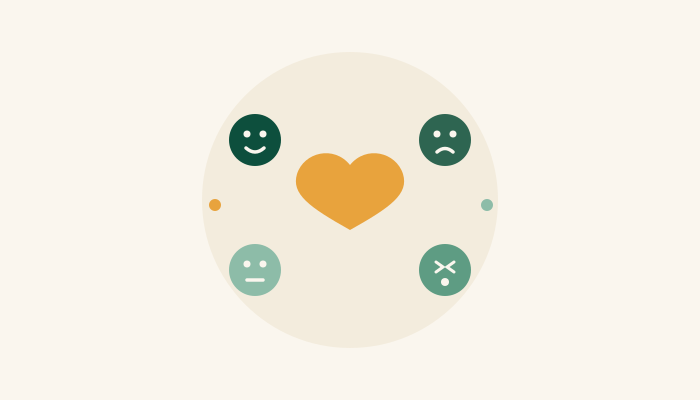
Mood charts. The toddler SEL power tool: draw or print faces showing different moods, let your child glue them onto a chart, practise making the faces together in the mirror, and label each one. Hang the chart low; when your child is sad, angry, hurt or afraid but has no words yet, they can point.
Elementary school
Play, upgraded. Board games bring concentration, turn-taking and time awareness; imaginative play continues, just more elaborately.
Art with narrative. Encourage your child to write and illustrate a story, or a comic strip, about how they are feeling, and sit beside them illustrating your own. Feelings that resist conversation often walk out through a pencil.
Mindfulness. Simple deep breathing and family yoga: children learn to tune into their bodies, which is where emotional regulation physically begins.
Middle school
Goal setting. The keystone skill of this age, feeding decision-making, analysis, time management and responsibility; it deserves deliberate teaching.
Mindfulness through the arts. Tweens often cannot say what is going on, but they can paint it, play it, sing it or dance it. Keep the arts channel open; it is their pressure valve.
Expression activities. Verbal and non-verbal communication norms, learned by doing: debate, extempore speaking, and hobbies like writing or sport that give feelings a form.
High school
Journaling. Encourage writing feelings down, and consider making it a family practice with a set daily or weekly time. A journal is a therapist that costs a notebook.
Arts, still. The stress-release and self-knowledge needs do not shrink with age; if anything, board-exam years raise them.
Presentation activities. Group discussions and presentations build the grown-up bundle at once: creative thinking, analysis, empathy and leadership.
SEL is not a subject squeezed between maths and science. It is the operating system the other subjects run on, which is why the 16 percent shows up in the marks.
For children with learning difficulties, SEL work matters double, because daily academic struggle taxes exactly the self-esteem and emotional regulation these activities build; the confidence side of intervention is never optional.
Dr. V.S. Gayathri is a Dyslexia Therapist, an Orton-Gillingham trained literacy specialist, and the founder of Flourishing Kids. She has delivered over 4,000 hours of one-to-one reading and spelling intervention, helping children across multiple countries build stronger literacy skills. with SEL woven through every session. To talk about your child’s emotional side of learning, get in touch for a free 15-minute conversation.