The different types of attention, explained for parents
By Dr. V.S. Gayathri ·
learning parenting
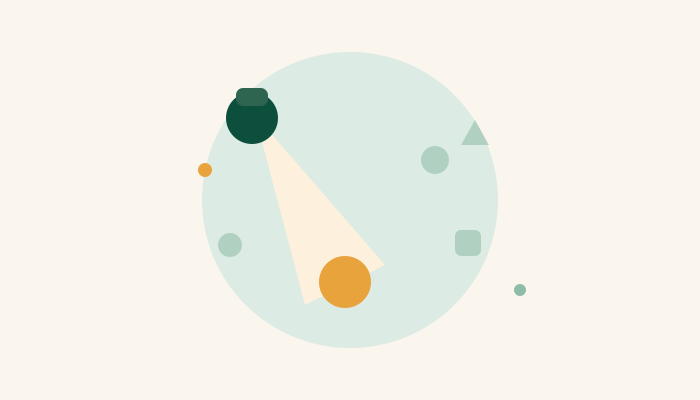
Attention comes in five types: focused (one task, distractions blocked), sustained (holding concentration over time), selective (picking one signal from noise), divided (two things at once), and alternating (switching between tasks). A child who “can’t pay attention” usually struggles with one specific type, and knowing which one changes how you help.
“Attention is vitality. It connects you with others. It makes you eager. Stay eager,” wrote Susan Sontag. Attention is key to growth and development, and children vary enormously: a child overly sensitive to sensory input may over-respond to the slightest sound, texture, sight or motion and struggle to follow simple commands, while another focuses easily even when challenged. When a child struggles to complete tasks, attention is one of the usual suspects, and understanding its types is the first step to helping.
1. Focused attention
Full attention on a single task, undistracted by outside stimuli, with everything else demoted. Also called executive attention, because it actively blocks the unimportant features of the environment; it is the attention we use when moving toward a particular goal.
Example: studying for an exam, or working on a project.
2. Sustained attention
Concentrating on a time-consuming task, holding attention across the minutes that learning, listening to lessons, and following instructions all require. One attention span runs in three stages: paying attention (you begin to focus), keeping attention (you sustain it), and ending attention (focus stops). Once attention ends, refocusing takes time, which is why children drift off, abandon a task, and return to it later. The good news: sustained attention improves with practice.
Example: reading a book or watching a film to the end. As school reading advances, chapter books and comprehension tasks lean ever harder on this type. (For building it, there are dedicated activities for babies and toddlers and for 4-to-7-year-olds.)
3. Selective attention
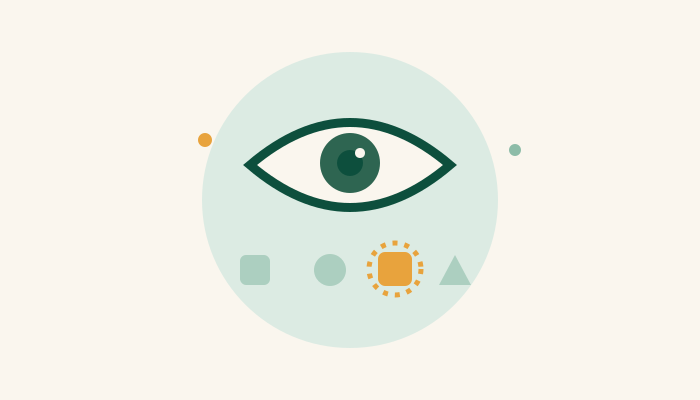
Focusing on a single stimulus in a complex setting: one voice in a noisy room, the teacher’s words over the lawn mower outside the window. The brain selects, consciously and unconsciously, the input that matters most from all the visual, auditory and tactile competition. The cost is real too: what gets filtered out is genuinely not perceived, even when it is important, which is how messages get missed and misunderstood.
Example: following one conversation at a loud family gathering.
4. Divided attention
Focusing on two or more things at once. Multitasking is harder than it looks, and the ability to hold several simultaneous points of concentration takes practice; age, agility and familiarity with the task all shape it. Some splits are manageable (chatting while tidying up), others are not (texting while talking to the person in front of you). For children: holding a conversation while playing.
5. Alternating attention
Switching focus immediately from one activity to another that demands different cognitive skills, and back again. It draws on all the other types plus mental flexibility.
Example: every teacher and parent alive, moving between the stove, the homework question and the sibling dispute.
“Pay attention!” assumes attention is one thing. It is five, and a child can be strong in four while one lags.
Why the types matter for your child
Because the help differs. A child weak in sustained attention needs tasks chunked and stamina built gradually; weak selective attention calls for quieter workspaces and reduced competing noise; weak alternating attention needs fewer forced switches and clear transitions. Labelling a child “inattentive” hides the specific, fixable thing. (One more curiosity from the research: the attentional blink: when two targets appear in quick succession, we tend to miss the second, though emotionally charged targets shrink the gap. Attention, like vision, keeps one thing sharp at the expense of the rest.)
Attention difficulties also travel with learning difficulties; a child whose working memory overflows will look inattentive when the real problem is capacity. If focus problems persist across settings and types, a proper assessment beats any amount of scolding; the early indicators are worth reviewing.
Frequently asked questions
Does trouble with attention mean my child has ADHD?
Not by itself. Attention wobbles have many everyday causes: poor sleep, anxiety, a task pitched too hard, or working memory running out. ADHD is a specific diagnosis, made by a qualified professional, when difficulties are persistent, show up across settings, and are clearly out of step with the child’s age. One weak attention type in one setting is not ADHD.
Can attention be trained?
To a useful degree, yes. Sustained attention builds like stamina: short, achievable stretches of focus, gradually lengthened. Selective attention is helped as much by the environment as by the child: a quieter corner, fewer competing signals. The realistic goal is a better fit between the task, the setting and the child, not a different child.
Which type of attention matters most for reading?
Sustained and selective. Decoding a page takes sustained effort, and a classroom demands selective attention against constant background noise. A child who reads reasonably at home but falls apart at school may have a selective attention problem rather than a reading problem, and that distinction changes what help looks like.
Dr. V.S. Gayathri is a Dyslexia Therapist, an Orton-Gillingham trained literacy specialist, and the founder of Flourishing Kids. She has delivered over 4,000 hours of one-to-one reading and spelling intervention, helping children across multiple countries build stronger literacy skills. If attention is the wall your child keeps hitting, get in touch for a free 15-minute conversation.