How to summarize and paraphrase effectively
By Dr. V.S. Gayathri ·
learning writing
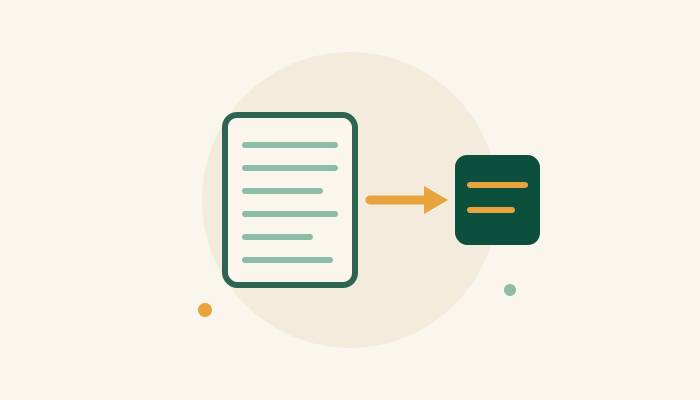
Paraphrasing rewrites a text in your own words at nearly the same length without changing its meaning; summarizing condenses it to only the main points. Both are learnable through the same core move: read carefully, put the original away, write from memory, then compare. For students, mastering the pair improves comprehension, memory, focus and communication all at once.
Summarization is an essential academic skill with a long professional afterlife, and paraphrasing is its close cousin, related but distinct. Knowing which to use, and how, is worth teaching explicitly.
What is paraphrasing?
Reading a text and rewriting it in your own words without changing the meaning, and without copying from the original. You take another writer’s idea and transform it into your own expression; the result is about equal to, or slightly shorter than, the original. Paraphrasing simplifies a text, supports your own point in line with the source, adds credibility and depth to your writing, and, usefully for students, makes material far easier to memorise.
What is summarizing?
Writing only the main idea and key points of a text, condensed in your own words: highlights without explanation. A summary is substantially shorter than the original. Use it to draw attention to an important point, or when you want some distance between your own thoughts and the source text.
The difference at a glance
- Paraphrasing rewrites the whole text in your own words; summarizing states only the main points.
- A paraphrase is roughly the length of the original; a summary is much shorter.
- Paraphrasing exists to simplify; summarizing exists to distil, with no explanation carried along.
Why teach summarization?
The benefits stack up quickly for students:
- Deeper learning. Writing a summary forces careful reading, often multiple readings, to reach the deeper meaning. Comfort with reading comprehension grows as a side effect, and the summarizer learns to separate essential ideas from clutter.
- Better study notes. A summarized text becomes a quick-review asset at exam time; the student revisits specifics instead of rereading everything. Time saved, twice.
- Sharper concentration. Summarizing trains the eye to lock onto the phrases and keywords worth keeping, which is focused attention practised on real material.
- Stronger communication. Repeated careful reading, meaning-hunting for unfamiliar words, and rewriting in one’s own words expand vocabulary and build fluency, spoken and written.
Summarizing is comprehension made visible: you cannot condense what you have not understood.
How to paraphrase, step by step
- Read the text very carefully and underline the important subject-specific words.
- Think of different ways to express the idea: phrases, synonyms, restructures.
- Simplify the vocabulary and sentence structure without changing the meaning.
- Put the original away and write the paraphrase from memory.
- Revise, then compare against the original for consistency of meaning.
How to summarize, step by step
- Read the text thoroughly; note the key points and subheadings.
- Use a dictionary for hard words, and re-read difficult sections several times.
- Take notes in pointers, capturing the main ideas.
- Put the original away and write the summary from what you remember.
- Compare with the original: does your version truly reflect the writer’s ideas?
- Add in-text references at the start or end. (In-text citations acknowledge other people’s work and let the reader distinguish your writing from your sources: a habit worth building early.)
The “put it away and write from memory” step is the engine in both routines; it is what forces genuine processing instead of clever copying, the same principle that makes retelling a story such a powerful comprehension check.
Both skills earn their keep in different situations; teach the difference, and let context pick the tool.
Dr. V.S. Gayathri is a Dyslexia Therapist, an Orton-Gillingham trained literacy specialist, and the founder of Flourishing Kids. She has delivered over 4,000 hours of one-to-one reading and spelling intervention, helping children across multiple countries build stronger literacy skills. If condensing a text is where your child’s comprehension breaks down, get in touch for a free 15-minute conversation.