How do logos help kids to learn?
By Dr. V.S. Gayathri ·
learning reading
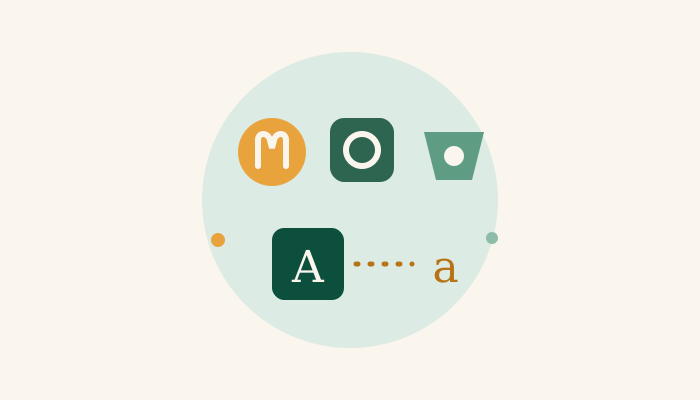
Logos help children learn to read because the brain recognises shapes and symbols long before it can decode letters. A toddler who spots the golden M without reading “McDonald’s” is in the logographic stage of reading, and parents can use that stage deliberately with logo memory games, sound matching and letter hunts.
Seeing is believing, and children learn most from what they see: tell them and they may forget, show them and they remember. That is why flash cards, Pictionary and interactive videos work, and it is why the logos all around your child are a free, ready-made reading resource.
You have almost certainly watched it happen. A child too young to read gets excited at the M of McDonald’s without reading a single letter of the name, or picks out the symbol of a favourite toy brand across a crowded shop. That recognition is not reading yet, but it is the road to it.
What does the science say?
In Reading in the Brain (2009), the cognitive neuroscientist Stanislas Dehaene explains that the brain has specific visual recognition areas where young children recognise faces and objects before they learn to read. In what he calls the pictorial stage, a child attempts to “read” words by their shape, letter patterns, colours and curvature, using the same face-and-object recognition machinery.
Frith’s psychological model of reading acquisition maps the progression in three phases:
1. The logographic stage
The child recognises the logo rather than reading it: favourite shops, restaurants, toy brands, the amusement park sign. Whole shapes, taken in at a glance.
2. The phonological stage
The child starts identifying smaller units within words, isolated letters and syllables, and becomes aware of phonemes: each letter has a sound. This is where phonics instruction does its work.
3. The orthographic stage
Reading becomes fluent. Reading time no longer depends on word length but on how frequently the word has been encountered; familiar words are recognised whole, at speed.
Logos give you a playful bridge from the first stage into the second, using symbols your child already loves.
How can you use logos for learning?
- Collect their favourites. Take coloured printouts of logos your child knows and keep them with the toys, in front of their eyes.
- Play the memory game. Show a logo, ask its name, then push one step further: “what’s the first sound of that logo?”
- Match the logos. Make a grid to match logos by first sound, or print black-and-white versions and have them match colour to monochrome, which pushes attention from colour to shape, exactly where reading needs it.
- Hunt the letters. Print the letters from a logo on their own and help your child identify them. Show how the same letter appears in different styles across brands and see if they can still spot it.
- Draw and recall. Ask them to draw a logo while you name the brand. For older children, give a letter and ask for two or three brands that use it.
Your child taught themselves to recognise fifty logos without a single lesson. The trick is to walk that same recognition, one first-sound question at a time, into the alphabet.
Games like these fold neatly into everyday reading beyond books, and they suit beginning readers especially well.
Dr. V.S. Gayathri is a Dyslexia Therapist, an Orton-Gillingham trained literacy specialist, and the founder of Flourishing Kids. She has delivered over 4,000 hours of one-to-one reading and spelling intervention, helping children across multiple countries build stronger literacy skills. If your child recognises every logo but the letters will not stick, get in touch for a free 15-minute conversation.