The Simple View of Reading: why some kids read words but miss meaning
By Dr. V.S. Gayathri ·
reading
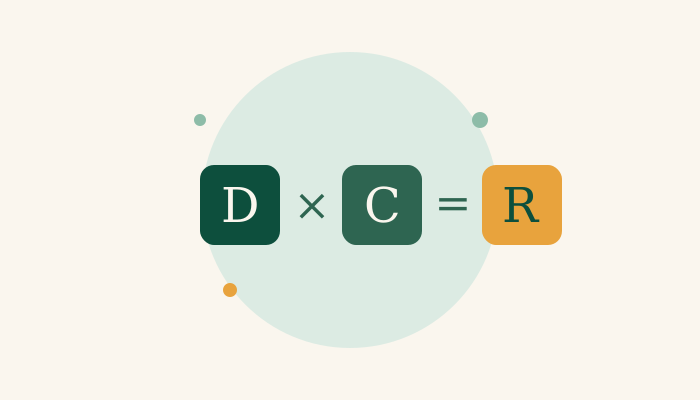
The Simple View of Reading, a model proposed by Gough and Tunmer in 1986, says that reading comprehension is the product of two skills: decoding (turning letters into words) multiplied by language comprehension (understanding what the words mean). Because the two are multiplied, weakness in either one collapses comprehension, and no amount of the other can compensate.
Reading is one of those skills we build young and use for life, and as children read more they normally move toward greater and greater comprehension. But not every child gets there the same way. Some have strong phonics and word recognition, yet fail to comprehend. Others show insightful understanding when you read to them, yet lose the thread when reading on their own. The Simple View explains both children with one small formula.
What is the formula?
D × LC = RC
D is decoding, LC is language comprehension, RC is reading comprehension. The model is called “simple” because it has only two moving parts. But each part deserves a close look.
Decoding is reading words from their sounds: the ability to turn what the eyes see into the right word sounds, more and more automatically. Phonics instruction exists to build decoding proficiency.
Language comprehension is the ability to understand spoken language: vocabulary, sentence structure, and the background knowledge a text assumes. When we simplify our words and sentences for very young children, we are adjusting for their still-growing language comprehension.
The detail that matters most: the two are multiplied, not added. If either one is zero, comprehension is zero. A child cannot brute-force their way past weak decoding with cleverness, nor past weak language with fluent word-calling.
Multiplication is the whole insight: a zero in either skill makes the total zero, however strong the other skill is.
English makes the decoding half harder than many languages. Hindi is largely transparent (letters reliably say their sound), while in English one letter can carry several sounds. That extra ambiguity is exactly why explicit teaching of both skills matters so much for children learning to read English.
The four kinds of readers
The formula produces four profiles:
- The poor decoder (D=0, LC=1, RC=0). This child struggles to work out what word the letters make. And if you do not know what the word says, there is no way to reach its meaning, however good your language is. This is the classic profile in dyslexia.
- The poor comprehender (D=1, LC=0, RC=0). This child reads the story aloud without difficulty, but ask what it was about and they cannot tell you. The words arrived; the meaning did not.
- Poor at both (D=0, LC=0, RC=0). This child needs support across all areas of literacy, and the effects compound over time without help.
- The fluent reader (D=1, LC=1, RC=1). No trouble with the words or the meaning. This is the goal of all reading instruction.
”My child can read everything, but still does not score well”
Parents ask me this constantly, and the Simple View gives the diagnostic:
- The child may be lacking language comprehension: some children answer beautifully out loud in conversation but cannot follow written passages, because text uses harder vocabulary and denser sentences than speech.
- Or a supposedly simple passage is actually costing the child heavy decoding effort, leaving no mental room for meaning. Listen to them read something unfamiliar; effortful, halting word-reading is the tell. (Fluent-sounding reading can hide this too; reading fluently does not mean reading fast.)
Either way, the fix is to strengthen the specific weak factor, not to assign more reading and hope. Reading is not a natural skill that develops on its own; it has to be taught the right way, and the right way depends on which half of the formula needs the work. A proper assessment identifies exactly that, and structured teaching rebuilds the weak side systematically.
Frequently asked questions
How do I tell which component my child is weak in?
Compare listening with reading. If your child understands a story well when you read it aloud but not when they read it themselves, decoding is the likely culprit. If they struggle to follow even when listening, work on language comprehension. A formal assessment makes this precise.
Can a child be weak in both?
Yes, and those children need the most urgent help, because both deficits grow if untreated. The good news: both respond to explicit, structured teaching, and progress in each multiplies through to comprehension.
Dr. V.S. Gayathri is a Dyslexia Therapist, an Orton-Gillingham trained literacy specialist, and the founder of Flourishing Kids. She has delivered over 4,000 hours of one-to-one reading and spelling intervention, helping children across multiple countries build stronger literacy skills. To find out which side of the reading formula your child needs help with, get in touch for a free 15-minute conversation.