What are decodable books and how do they help early readers?
By Dr. V.S. Gayathri ·
reading learning
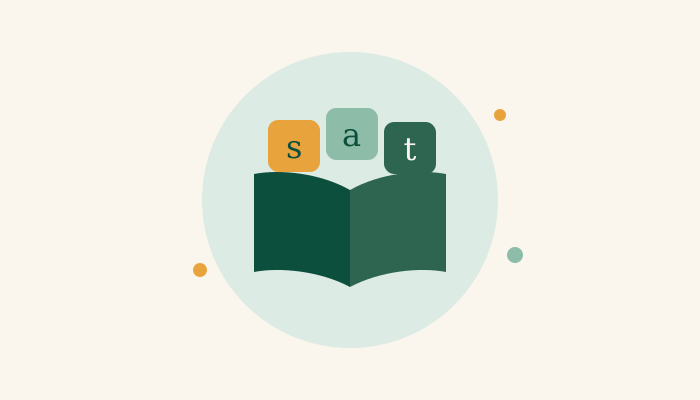
Decodable books, also called phonic readers, contain only words a child can read with the phonics they have already been taught. Because every word can be sounded out, the child decodes instead of guessing, reads independently from the very first page, and builds confidence with each small success. They are the training wheels of reading, used for a season and then outgrown.
There are many ways to help a beginning or emergent reader, or a child with reading difficulty, and the main idea is always the same: give them resources they can actually interpret. Research indicates that teaching elementary students phonics is the most reliable way to make sure they learn to read words, and decodable books put that principle into a child’s hands as an actual book they can finish.
What makes a book “decodable”?
Each book focuses on a specific phoneme (sound) or grapheme (spelling) for the child to practise. They usually come in series: the first books use very simple words, and complexity grows as the child progresses until the books look like any other reader. The difference is that at every step, the child is only ever asked to read the part of the phonic code they have already learned.
For example: Sam is a fat rat. The rat sat. A beginning reader who knows the sounds of s, m, t, r, f and the vowel a can read nearly every word, with perhaps one or two high-frequency words like the that they already know by sight. The child reads a real sentence entirely by themselves, and that changes how they feel about reading immediately.
Decodable books vs levelled books
The two get confused. In decodable books, the words are built from letter-sounds the child already knows; the text serves the phonics. Levelled books instead use predictable sentence structures with pictures that carry the meaning, graded by age and difficulty. A child can appear to “read” a levelled book by using the pictures and the pattern, without decoding much at all, which is exactly the guessing habit that undermines later reading.
Decodable texts come as picture stories for beginning readers, “chapter books” for emerging readers, and printable books.
How do decodable books help?
Research supports using decodable text for a short period, right when a child is first learning to sound out words, and studies suggest children reading them are more likely to read words accurately. The benefits stack:
- Decoding automaticity. The child learns to decode independently and starts looking forward to reading more.
- Practice in context. Known phonics gets exercised inside an actual story, which brings some comprehension along.
- Blending, not guessing. Unfamiliar words get blended from their sounds; the child learns they can work out new words alone.
- Self-confidence. Immediate success, experienced on every page, builds enthusiasm. For a beginner this self-reliance is the whole game.
- Systematic progression. Good decodable series go step by step rather than scattering phonics concepts in a disjointed way, the same principle behind structured literacy teaching.
- A bridge to fluency. Decodable books are a big step toward fluent, independent reading.
A decodable book makes the child a promise: every word in here is one you can work out. For a struggling reader, that promise is everything.
How do you choose them?
Two criteria: the book should be engaging for the child, and it must match the phonics patterns being taught. That second one is strict; if the text contains phonics the child has not learned, it is no longer decodable for them, whatever the label says.
Two common complaints have easy fixes. “Too simple, no deep comprehension”: supplement with read-alouds and richer texts, where you carry the complexity for them. “Unnatural sounding”: choose series with more natural language; the good modern ones read far better than the rat sat.
How do you use them?
- Highlight words with the target phonics pattern, so the child connects the concept to real reading.
- Discuss the meaning of the text, always. Decoding practice never excuses skipping comprehension.
- Read the text several times for fluency practice; this is repeated reading with a perfectly matched text.
- Respond in writing, using at least some words from the text.
Which series are worth trying?
- Bob Books: the classic starter series by Bobby Lynn Maslen, designed for the very first steps of reading.
- Usborne Phonics Readers: lively rhyming tales that introduce a wide variety of phonemes.
- S.P.I.R.E. Decodable Readers: around 120 readers covering science, social studies and literature, with multiple selections per concept.
- Dog on a Log Books: sound-out books that start from just a few phonics rules, built with dyslexic readers in mind.
Dr. V.S. Gayathri is a Dyslexia Therapist, an Orton-Gillingham trained literacy specialist, and the founder of Flourishing Kids. She has delivered over 4,000 hours of one-to-one reading and spelling intervention, helping children across multiple countries build stronger literacy skills. decodable readers in hand. To find the right reading material for your child’s exact stage, get in touch for a free 15-minute conversation.